Podcast: Download (Duration: 23:23 — 18.7MB)
Get notified of new episodes: RSS
This episode of Talking Law looks at what protects an Australian business importing from China to Australia when it signs a contract with a Chinese manufacturer. Shan Lai, Special Counsel at Aspect Legal, joins Joanna Oakey to unpack the IP step most buyers skip, why an Australian court judgment often can’t be enforced in China, and what to check before you sign.
If you’re manufacturing in China, buying from a Chinese manufacturer, or importing from China to Australia, this episode is for you.
In this episode of Talking Law, host Joanna Oakey is joined by Shan Lai, Special Counsel at Aspect Legal, to unpack what actually happens when a supply deal with a Chinese manufacturer goes wrong – and what most Australian businesses get wrong before they even sign.
Shan has spent 15 years working in Beijing and now leads Aspect’s commercial work with Chinese clients.
In this episode, they cover:
- The one IP step most Australian buyers skip – and why protection in China starts the day you file
- Why an Australian court judgment often isn’t worth the paper it’s written on, and what to use instead
- Why a bilingual contract needs a lawyer checking both language versions, not just a translator
- Why Chinese law lets you write in a real penalty clause – something Australian law won’t allow
- Why rising labour costs are changing the cost of buying from China to begin with
This is a practical listen for any Australian business manufacturing in China or importing from China to Australia, or thinking about it, and for the brokers and accountants who advise them.
ABOUT SHAN LAI
Shan Lai is Special Counsel at Aspect Legal, leading the firm’s commercial law work with Chinese clients and its SME business sales and acquisitions team. She has 28 years of experience across China and Australia, including 15 years in Beijing, 6 of them as a Corporate and M&A Partner at Bird & Bird, one of the world’s leading international firms. In Beijing, she advised Chinese state owned enterprises on global acquisitions across more than 20 countries, and advised multinationals including Boeing, Macquarie Group and McGraw-Hill on entering and operating in the Chinese market.
Fluent in Mandarin and Cantonese, Shan works directly in the language and the culture of her clients, without an interpreter in between. She acts for Chinese businesses launching into the Australian market or buying a business here, for Chinese owners already operating in Australia, and for Australian businesses selling into the Chinese market.
Connect with Shan Lai
- LinkedIn: linkedin.com/in/shan-lai-407007147
- Email: [email protected]
- Book a free 15-min call here: Book now
Learn more at www.aspectlegal.com.au.

Episode Highlights
0:00 – Intro: contracting with a Chinese manufacturer
1:13 – What’s different about buying from China?
1:29 – Why rising labour costs are changing the picture
3:17 – How Chinese manufacturers think about contracts
6:02 – What you can (and can’t) negotiate
8:01 – Retention: don’t pay in full before you check the goods
10:00 – Why a bilingual contract needs a lawyer, not just a translator
11:13 – When “must” gets read as “suggestion”
12:04 – What goes wrong: governing law vs dispute resolution
13:50 – Why an Australian court judgment can’t be enforced in China
14:40 – Arbitration and the New York Convention
16:59 – Protect your IP: register in China first
18:34 – The one thing to check this week
19:42 – Spell out quality standards, and the penalty clause
21:07 – Key takeaways and the free China checklist
FREQUENTLY ASKED QUESTIONS (FAQs)
Q1: Is my contract with a Chinese manufacturer actually enforceable?
Shan Lai says most Australian buyers use only a basic purchase order, not a full supply agreement, and don’t realise an Australian court judgment generally can’t be enforced in China (no bilateral treaty). Arbitration under the New York Convention (e.g. CIETAC or Hong Kong) is the route that actually works.
Q2: What’s the one thing I should check about IP before I sign?
Shan Lai says register your IP in China first – protection starts on the day you file, and Australian registration doesn’t extend to China. This is the step most buyers skip.
Q3: Does a bilingual contract need more than a translator?
Yes – Shan Lai says a lawyer needs to check both language versions, since even qualified translators can shift the emphasis of a clause enough to change how each side reads their obligations.
Q4: Can I use a penalty clause in a contract with a Chinese supplier?
Shan Lai explains Chinese law allows a genuine penalty clause, which Australian law generally doesn’t enforce (Australian contracts use a liquidated damages clause instead) — a real point of leverage buyers often don’t know they have.
Q5: What is an NNN agreement, and how does it protect me with a Chinese manufacturer?
An NNN agreement is a contract with a manufacturer that covers three things: non-disclosure (they keep your designs and information confidential), non-use (they don’t use that information for anything other than your order) and non-circumvention (they don’t go around you to deal directly with your customers or suppliers). It is usually signed before you share designs or specifications. Because it has to be enforced where the manufacturer operates, it is usually drafted to work under Chinese law. It sits alongside registering your IP in China first, which Shan says is the step most buyers skip.
Note: this transcript was generated automatically, so it will contain errors. It’s here as an easy way to scan for anything relevant to you, not as a word-perfect record of the episode.
(00:15) Joanna Oakey: Hi, it’s Joanna Oakey here and welcome back to Talking Law, a podcast proudly brought to you by our commercial legal practice, Aspect Legal. In this episode, my colleague, Shan Lai, who is a commercial and M&A lawyer with more than 29 years experience across Australia and China, covers what contracting with Chinese suppliers actually looks like, why your jurisdiction clause matters more than you think, and the one IP step every business should take first. It’s a fascinating one, so let’s jump straight in. Shan, thank you so much for joining us today on Talking Law.
(00:55) Shan Lai: Thank you. Thank you very much for inviting me.
(00:58) Joanna Oakey: My pleasure. All right. So, let’s get into it. Today, we’re talking about Chinese suppliers. So, you’re an Australian business looking to go and add a Chinese supplier into your supply chain.
(01:12) Shan Lai: Yes.
(01:13) Joanna Oakey: And I guess like high level, what are the differences, Shan, perhaps between sourcing supplies from Australia and sourcing supplies from China. What should our listeners be aware of as they’re contracting?
(01:29) Shan Lai: Okay. I think, obviously, China has traditionally been a favourable sort of a country or origin to source supply because we perceive the pricing, obviously, is very good. And also, I guess, the turnaround, as I understand, because they really can mass-produce and provide whatever the order is. I think the trend is changing a little bit. China has traditionally been
(02:06) Shan Lai: Almost the sole place to go to because of its mass labor and cheap price. But lately, I mean, I think not so lately, since the rise of, as you call, Vietnam or Philippines or other, where you have even cheaper labor. And I think in China, there’s a trend that the Chinese government is trying to enforce quite strictly on labor law. So the Chinese labor law is very protective towards employees now. And that, as far as I understand, causes quite a great concern for whether it’s foreign entities operating in China or from our perspective, if you are buying, sort of supplying, sourcing suppliers from China, the cost factor has gone up because of the labor cost has gone up. So that’s what I can see as a trend. But having said that, I think it is due and will be for a long time to come, it’s still a very favourable source of, you know, supply, yeah, for one reason or the other.
(03:17) Joanna Oakey: And I guess, you know, Australian businesses who are contracting with Chinese suppliers, they’ll have a lot to think about from a contractual perspective that perhaps, you know, perhaps initially the decisions that they’re making are based on sourcing availability, sourcing pricing. But, of course, within that is a difference in a contracting regime. What are the biggest differences in a contracting approach that Australian businesses might be used to that’s actually different in dealing with a Chinese business?
(03:53) Shan Lai: Okay, so from purely like contracting basis, I think for the Australian entities who may be more sophisticated, we are sort of having in mind, you know, you have a whole readily or almost like a prison type of supply agreement that I’m ready to enter into and that will have sufficient provisions to protect me as, you know, as a buyer. But whereas from the Chinese perspective, I think for my, you know, over my years in China, It’s good to see that the concept contract is gaining its momentum. So previously, people, particularly for small suppliers, you know, contracts probably two words written on tissue paper. That’s valid.
(04:46) Shan Lai: But having said that, I think the concept of contract, it is still very at a very elementary stage. People are more used to this conceptual, you know, the Chinese love to just talk about ideas, right? So nothing more than two pages. You want to buy this, I supply for you, and this is the price, and that’s it. So nothing about concrete terms, you know, the quality, the payment mechanism, the breaching and the obligation and the moratoriums. Those are still very much in a developing stage. I think for the Australian entities going to enter into contract, you need to have that in mind. you’re never going to get a full-blown Australian-style contract. So that’s too difficult and probably not practical in any circumstances. But you can still insist on the major provisions that’s crucial, whether it’s in Australia or whether it’s in China, that will protect literally both parties. So I think that’s sort of the whole context and the background of it. And then we can obviously dive into a lot of more specifics of the contracts if we want.
(06:02) Joanna Oakey: Well, let’s do that. Let’s get into the specifics. What are the things that you think, and I think the reality, I’ve certainly seen this myself as well too, Sian, that Australian businesses want the kind of contract they have here in Australia. They face this issue that they’re dealing with a counterparty who deals with, the legals in a different way. How do you find that meeting of the minds and, what are the things that you think you can negotiate to have in a contract with a Chinese supplier versus those that maybe become less important?
(06:41) Shan Lai: Yeah, so it’s interesting because I have heard so many times from the Chinese perspective, like, why do we need it, you know? Couldn’t we just work it out? Because that is the pragmatism in Chinese culture, I guess. All you need is just for us, we’re just heads of agreement. For them, that’s it. That’s the whole of the contract. So that’s number one. But having said that, I think they are still open to discussion. And I’ve seen many success stories where the foreign parties are able to bring to, I guess, logic and common sense. And maybe we just say that that’s the way that we need to do business. You know, that’s how we can have our board pass the resolution to approve this deal. There’s things like that. Oh, okay. You know, like if they want to do a deal, they have to compromise as well. So therefore, on the commercial terms, I think whether it’s Australian or whether it’s Chinese or whether it’s any other countries, the elements of the commercial terms are still there. You know, payments, whether you have structured payments or whether you have retention. I think from an Australian standpoint,
(08:01) Shan Lai: Contracting part of you, if you’re getting supplies from China, it’s always important to get retention. Don’t pay the whole amount until you get the goods and you check, that’s okay. Because once you pay, then you’re negotiating, and we can talk about enforcement later, it’s very much diminished. And also, the other elements of the contract, and we can just dive is about the languages, right? I think for Australian parties, they always want to say, so now it’s quite natural to have bilingual contact, particularly with AI, because nobody needs any translators now. So we can all sort of, you know, generate our dual or however many language versions, but then as to say which language you will provide, the Australian parties always want to say, I want English to provide, right? And the Chinese will say, no, no, no, I don’t get it. So it’s always an argument. The Chinese court is very interesting. You know, whereas our English court will require clarity and blah, blah, blah. So you always want one to prevail, not the other. Whereas the Chinese say, hey, let’s just work it out. So they’re happy for you to put under the contract. Both languages prevail. And then, you know, yeah.
(09:22) Joanna Oakey: I love that both language prevail. I love it.
(09:26) Shan Lai: And then when the issue comes up to say, you know, if there’s a discrepancy, the court just literally takes, you know, puts on the hat to say, I’m the party then. Let me think, what was my true intention? And yeah, so I guess something is probably It’s unimaginable within the Australian context, but it’s quite comfortable in the Chinese context is because what they don’t care about legal principle is such. What they’re interested is just to find a solution.
(10:00) Joanna Oakey: And I guess like it’s interesting that you say, Sean, well, you know, so we don’t need a translator anymore because we have, you know, we have AI. But it seems to me you still need that cross-check to make sure someone who understands law, and understands both languages has been able to have a look to see that actually they’re both saying the same thing then. Because it seems to me from what you’re saying.
(10:26) Shan Lai: Sian, it’s kind of a risk. So two things. So one is that absolutely you need a lawyer who is able to read both language versions to, number one, confirm actually the translation is correct, right? I think that’s something you need. And also to explain to the client, whether it’s in English or in Chinese, so that they can understand it. I think so many times, even with the contrast of what it says, The parties coming from wherever their perspective from, they actually understand the provisions, whether it’s in their language or not, from a totally different perspective and therefore understand it to be totally different.
(11:13) Joanna Oakey: And have you seen examples of that, Sian, where there’s been, well, I guess what you’re also saying is maybe there’s a cultural difference in the interpretation of some of these.
(11:24) Shan Lai: Exactly. I think with the English language, you know, when we say shall, will, must, we feel that’s quite the same. And I think when we translate, and I’ve worked for different translators, they are qualified legal translators, but each of them have their own ways of translating. So when they put that into Chinese, they have a different emphasis, and the Chinese clients or the counterparty actually interpret quite differently. So depending on what kind of words they use, they might interpret that’s not a must. That’s just a suggestion. Very interesting. Wow.
(12:04) Joanna Oakey: Yeah. So I’m picking up here. Translation is such an important component of all of this translation whilst understanding the nuance from both cultural perspectives of the words that you’re actually using. And have you seen, like, have you seen any examples of where things have gone wrong in contracting between Australia and Chinese entities?
(12:33) Shan Lai: I guess, you know, number one, the biggest dispute is whether we want Australian law to apply or Chinese law to apply, right? I mean, now I might be saying the wrong thing, but I actually think Chinese contract law, they’re based on, I think, very much of the westernized version of it. They obviously referenced a lot. I think the contract law is quite commercial and fair. So whether we need to insist on Chinese law to apply or Australian law to apply, that’s a bit academic. But I can understand the preference because we understand what Australian law is the way more comfortable. But there are two distinct concepts. One is which law applies and number two is the DR process and which court applies. So it’s all very good. You have an Australian law contract and you say that if there’s any dispute then we take it to the court And then you go to Australian court and you’ve got a judgment. Unfortunately, the judgment is, at best, academic. It’s not even worth the paper. It is written on.
(13:50) Shan Lai: Because China doesn’t recognize foreign judgment unless we have a bilateral treaty, which Australia and China doesn’t have. So an Australian court cannot be enforced in China. I mean, very funny, like black-letter law, there’s nothing in Chinese law to object to it. But if in real life you try to say I’ve got Australian court judgment and then go through the Chinese legal system trying to recognize this Australian court judgment, it’s not even worth trying. So therefore, number one, whether Australian law or Chinese law aside, it’s the DR, it’s
(14:40) Shan Lai: Jurisdiction and DR clause, that’s very, very important. And therefore, we’ve always advised Australian clients to use arbitration. It is because Australia and China are both parties to the New York Convention. So we’re all signatories to the treaty. And therefore, any arbitral award can be easily enforced in China. And that’s been given again and again from state level to whatever, you know, multinational companies, international companies to any private companies. So that is very important. And then in terms of the arbitrations, again, there’s these elements of what I’m used to. So from the Australian party, you know, CTAG is the Chinese economics arbitration venue. So would CTAG be so protective of this Chinese counterparty or will not? I’ve actually dealt with CTAG quite a bit. I think they’re pretty fair. I don’t see a lot of protection, sort of national protectionism in it. But if they’re not comfortable, I think the Chinese parties are quite comfortable with the Hong Kong arbitration.
(16:02) Shan Lai: Although I’ve seen some readings and not so much in real life, but in real cases. But because this Hong Kong now, you know, going back to China and there’s been huge judicial argument whether they still have judicial independence. So Singapore now comes to play. So you can opt for a thinkable arbitration venue, and largely, by and large, the Chinese part is quite comfortable with that as well.
(16:29) Joanna Oakey: Fascinating. So fascinating that maybe SMEs in negotiating, if they don’t know what they’re doing, are spending too long negotiating a position that isn’t particularly useful to them, for example, from a jurisdiction perspective. What else? What else do you think are terms that protect SMEs in contracting, with Chinese suppliers that maybe SMEs are getting wrong in this negotiation?
(16:59) Shan Lai: Probably, not sure about getting it wrong, but one thing I think you can never avoid is the IP issue, right? Yeah. China is known for its non-protection of IP.
(17:10) Shan Lai: Don’t know whether it’s through the lack of government control or just because, you know, just agreed. Yeah, so one thing, funny, the Chinese always say, you know, like, they don’t invent things. Oh, look, this could be over-generalization in the largest way possible, right? A lot of times what they’re saying is that we don’t invent things, right? But don’t you invent something. If you ever invent something, we will make it much better and cheaper and just destroy you. So that is the stigma. So you come up with an idea if you wanted to go to China, get your cheaper supplier manufacturer done, then you have to try to get your IP protected. And therefore, I think IP registering in Australia doesn’t extend to Chinese jurisdiction. Always go to number one to get Chinese IP registration because protection is by filing. So again, I think everywhere with IP registration, I understand same in Australia. It takes forever to get the registration. But the protection actually comes in fact on the day of your lodgement. So obviously, I think that is so easy, so effective, and relatively cheap as well. So that’s something that I’d say everyone going to China should try to do as a first step.
(18:34) Joanna Oakey: Love it. And, I guess if a business has a Chinese supplier, has never had the contract looked at, but, you know, listens to this, realises, you know, maybe they need to have a bit of a think about whether or not, what they’ve got written on paper is actually going to stand up for anything. What is the one thing that you would recommend that they check this week? And I guess we’ve talked about sort of two things.
(19:04) Shan Lai: Yeah, I think jurisdiction is very, very important. Yeah, that’s number one, because otherwise, if you can’t enforce a contract, then doesn’t really work, relate… Um, other things, I think, uh, commercial terms are largely, I think, applicable both in China and Australia in some context. But I do have a look at these, um, retention amount, um, and then the quality checks. One thing interesting I wanted to raise is just come to mind. Yeah.
(19:42) Shan Lai: Because I think for Australian sort of entities, it’s important to spell out very, very clearly of the qualities and, you know, whether the product has to meet the Australian standard. A lot of times, if you are very vague about it, the Chinese are likely just to take advantage of the vague language. So I think you really, and obviously for every single industry have their different wording and different particulars and stuff like that. But you can build in penalty clauses. Because you know how in the Australian or in our common law system, in a contract you cannot enforce penalty because that’s the function of the court. So therefore you have to have a liquidated damage clause to say parties agree that, you know, if you’re breaching, this is pretty much the damage I will suffer. There’s such a concept in China, on the Chinese law. You can penalize them. Wow. Yeah. Yeah, exactly. You can make them realize that if they breach the contract, they will really hurt. Not, you know, necessarily you will be successful in forcing that, But at least, you know, you can instill enough caution, enough awareness that they take notice of that.
(21:07) Joanna Oakey: I love it. What a fascinating run through. Like so many interesting things that have come up here. Obviously, be very careful in the translation and the translation, can have very different meanings.
(21:22) Shan Lai: Even similar sort of words.
(21:24) Joanna Oakey: And I love this. There might actually be some reasons, and it sounds like there certainly are, some benefits of choosing a jurisdiction outside of Australia, which might be contrary to what our listeners thought. And we even have a regime that’s open to us by having penalty clauses, if we would, rather than the prevention here. No genuine pre-estimate required.
(21:49) Shan Lai: Exactly. How interesting.
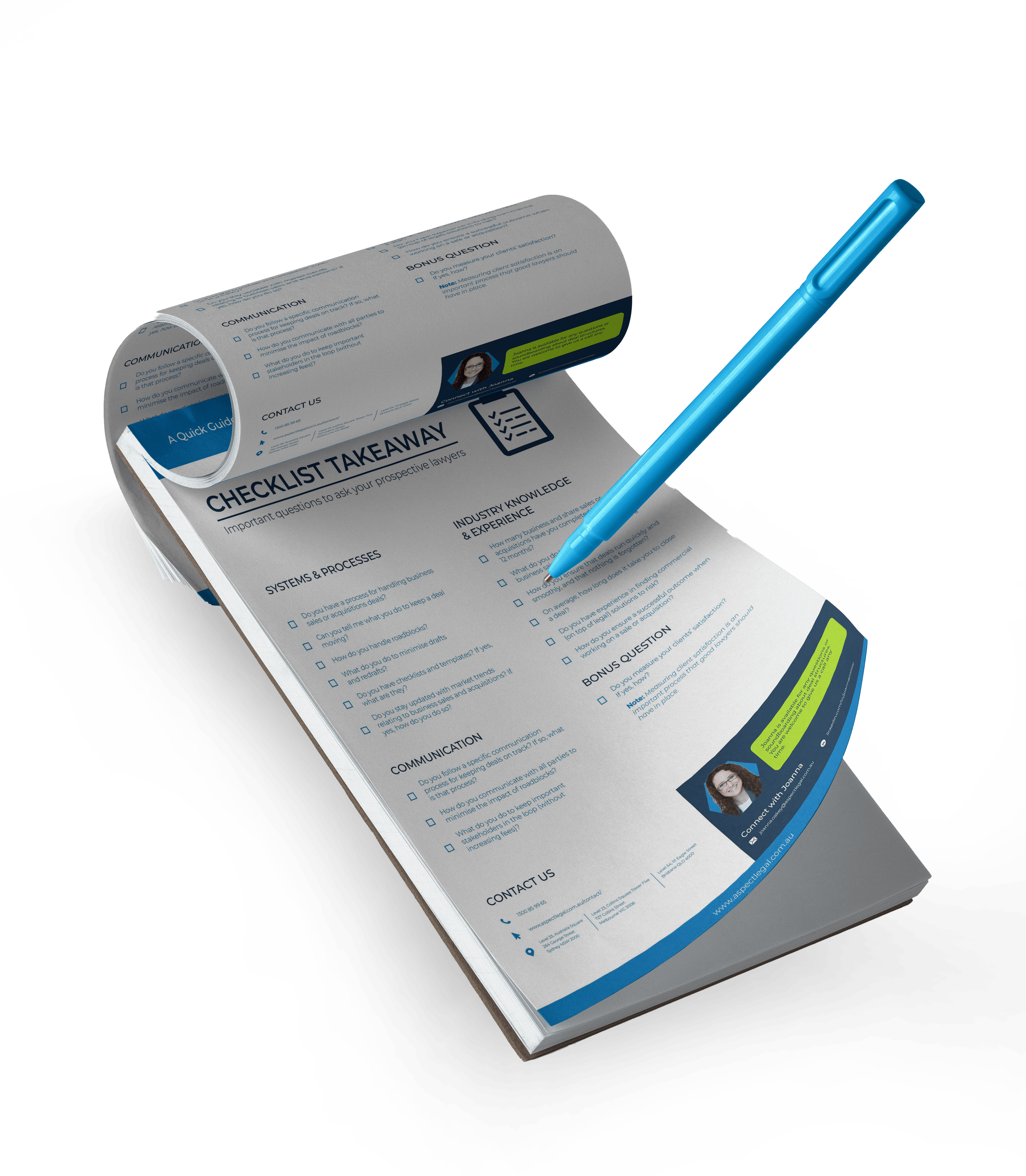
(21:51) Joanna Oakey: I love it. Sian, this has been absolutely fascinating. We will have available for our listeners a little checklist. So, if you’re thinking of engaging with a Chinese supplier, then download our checklist from this episode and, it’ll give you some tips along the way in best practice for contracting. Shan, can I just say a huge thank you for coming on to Talking Law today?
(22:18) Shan Lai: Not at all. I love it.
(22:20) Joanna Oakey: Well, that’s it for this episode of Talking Law. If you enjoyed this one, make sure you subscribe so you never miss an episode. And if you’re dealing with Chinese suppliers or about to sign a contract, we’ve put together a free guide about doing business in China, covering trademarks, supplier contracts, dispute clauses, and more. Grab it via the link in the show notes. And if you’d like to book a call directly with Sian or the team at Aspect Legal about your own situation, head to aspectlegal.com.au or check the show notes for a direct link. Thanks again for listening in. You’ve been listening to Joanna Oakey and Talking Law, a podcast proudly brought to you by our commercial legal practice, Aspect Legal. See you next time.
(23:09) Announcer: Thanks for listening to Talking Law. Tune in next time for more smart legal tips and tricks to keep you clear of those legal landmines. If you want to get a download of today’s show notes, head over to talkinglaw.com.au.
Disclaimer: The material contained on this website is provided for general information purposes only and does not constitute legal advice. You should not depend upon any information appearing on this website without seeking legal advice. We do not guarantee that the contents of this website will be accurate, complete or up-to-date. Liability limited by a scheme approved under Professional Standards Legislation