In this episode of The Deal Room Podcast, host Joanna Oakey is joined by Shan Lai, Special Counsel at Aspect Legal, to look at who is actually buying Australian businesses from China right now, and what that means for sellers and their advisors.
Shan has spent 15 years working in Beijing and now leads Aspect’s commercial law work with Chinese clients. In this episode, they unpack:
- The shift from state owned enterprises to private Chinese buyers, and why that changes the deal
- Why health and wellness has become a priority sector for Chinese investment into Australia
- What Chinese buyers most often misunderstand about Australian corporate structure and documentation
- Why China’s foreign exchange controls can delay settlement even when the buyer is acting in good faith
- How brand and goodwill get protected once ownership crosses into a new jurisdiction
- Why trust, language and cultural fluency change the outcome of a transaction
This is essential listening for anyone selling to a Chinese buyer, or advising a client through that process.
Tune in now on The Deal Room Podcast.
ABOUT SHAN LAI
Shan Lai is Special Counsel at Aspect Legal, leading the firm’s commercial law work with Chinese clients and its SME business sales and acquisitions team. She has 28 years of experience across China and Australia, including 15 years in Beijing, 6 of them as a Corporate and M&A Partner at Bird & Bird, one of the world’s leading international firms. In Beijing, she advised Chinese state owned enterprises on global acquisitions across more than 20 countries, and advised multinationals including Boeing, Macquarie Group and McGraw-Hill on entering and operating in the Chinese market.
Fluent in Mandarin and Cantonese, Shan works directly in the language and the culture of her clients, without an interpreter in between. She acts for Chinese businesses launching into the Australian market or buying a business here, for Chinese owners already operating in Australia, and for Australian businesses selling into the Chinese market.
Connect with Shan Lai
- LinkedIn: linkedin.com/in/shan-lai-407007147
- Email: [email protected]
- Book a free 15-min call here: [Book now]
Learn more at www.aspectlegal.com.au.

Episode Highlights
00:01 – Chinese Buyers in Australia
02:00 – Mining to Health Shift
06:15 – Australian Legal Basics
07:45 – Contracts and Clarity
09:40 – Foreign Exchange Hurdles
13:56 – Laws, Liabilities, and Trust
17:25 – Protecting Brands and IP
19:37 – Success Through Preparation
Note: this transcript was generated automatically, so it will contain errors. It’s here as an easy way to scan for anything relevant to you, not as a word-perfect record of the episode.
(0:00) Announcer: Ladies and gentlemen. Are you ready? Okay, here we go. You’re listening to The Deal Room Podcast. Join us as we bring you the inside scoop on business sales and acquisitions. Get across trends in the area and hear the industry’s best recovery.
(0:24) Joanna Oakey: Hi, it’s Joanna Oakey here and welcome back to The Deal Room Podcast, a podcast proudly brought to you by our commercial legal practice, Aspect Legal. Now in this episode, I’m joined by Sian Lai from Aspect Legal. Sian’s a commercial and M&A lawyer with more than 29 years experience across Australia and China. And this time we talk about how Chinese investment in Australia is shifting, foreign exchange controls and why they catch sellers off guard, and what Chinese businesses often most underestimate about operating here in Australia. I think you’ll find this one really eye-opening, so let’s get into it. Sian, welcome to the Deal Room Podcast. I’m so excited to have you on the show.
(1:13) Shan Lai: Thank you. Thank you for inviting me.
(1:15) Joanna Oakey: Fantastic. I love having you on the podcast, Sian, and talking about all of these things, China-related. You have got so much wealth of information. I guess having sat in both the Australian advisor capacity, but then having lived and worked in China for so many years, you bring such an interesting, um, I guess, experience and viewpoint. So why don’t we start, there’s so many things that I want to talk about today, but really why don’t we just kick it off with, um, I think we’ve had discussions in the past where you’ve talked about the, um, changing nature of the type of Chinese buyer who’s buying into the Australian market. Where are you seeing that right now? What has been the change over time?
(2:00) Shan Lai: I think, okay, I think traditionally, I think, you know, Australia being the mining country, back in, let’s say, 2010, around 2010, there was a huge mining boom. And I think the SOEs are trying to invest heavily in Australian mining industries, agribusiness industries. To me, that trend seems to subside a little bit. But having said that, I think there was also an attempt by the Chinese real estate trying to invest. I think, you know, following the Japanese footstep, you know, how we talked about the Gold Coast was literally bought by China. Or Japanese conglomerates, but I think they have now exited the market, whereas the Chinese has to come in. I think from what I can see, the Chinese developers, Evergrande, although Evergrande’s gone down now, right? It’s the biggest, biggest market buster in China. But they did come to Australia. And close to where I live, you know, in Isu, There are a couple of shopping towns that’s actually being developed by Evergrande. So I think there has been a trend. The Chinese, and I know for a fact that they have come into Australia buying real estate with the intention to develop. And I understand that a lot of them have encountered a lot of difficulties because they are not familiar with the planning control of Australia. They can’t deal with the Australian construction industries because we are so industry protected. So even on a personal level, I have known Chinese developers coming here, not on the SOE, you know, state-owned enterprise. Level, but small developers coming here prepared and ready to invest a lot, only to make a lot or ready and all just to flock it off. Because I think the Australian property development aspect has proven to be quite difficult. So now I see a lot of private-owned enterprises coming to different sectors, like health sectors. I think the Chinese society is so into health. If you’re ever in China, you have pharmacies, chemists, pharmacists, chemists, like 10 of them in a row. I don’t know why, but there are a lot. So I think, you know, because of the scarcity in resources, the Chinese population, individuals and communities are quite focused on health. And, you know, Blackmore is quite big in China because of the health supplements and stuff like that. So there have been, I think, a focus to get into Australian health and healthcare industry. I understand the Chinese are looking at getting to the healthcare industry, but NDIS has proven to be quite difficult. But so the whole thing is that there’s a shift from the aloof SOEs going to the major investment and now actually coming into the Australian different sectors, and then on the smaller scale.
(5:23) Joanna Oakey: And so if you’re thinking about a Chinese buyer coming in, so I guess coming into Australia from a business perspective, you know, you could have the Chinese businesses looking at doing a startup here in Australia, bringing their own brand or buying a business here in Australia. But whichever method, you know, a business was looking at to come offshore to the Australian market, still there’s a whole heap in the way Australian business is run, the Australian economy runs, the culture of business here that’s different to China. What do you think, having sat in both countries from a business perspective, what do you think the key things are for anyone who’s coming from China to Australia to understand in terms of what the nuance is of doing business here in Australia?
(6:15) Shan Lai: I think number one is that they need to understand our, I think, the corporate structure. I think even though the company law in China has been in place for quite some time, but I think we have a more, complex corporate structure, corporations law, dealing with director’s duties, and just… Following that legal advice and getting the proper legal setup is quite important. So they need to, someone needs to explain to them what they need to sort of observe and understand to operate properly within this Australian context. That’s quite important.
(7:07) Joanna Oakey: Interesting. And what else? I mean, from a contractual perspective, we’ve had discussions before, Sian, about the difference in contracting in China from a very practical perspective as opposed to Australia being a very, well, it sounds like a document-heavy perspective in comparison to China. What is your advice to Chinese business owners coming into Australia in terms of making sure they don’t under-document the deal? Like, why is it important in Australia to understand the Australian documentation approach here?
(7:45) Shan Lai: I think, you know, the logic is in reverse, right? For Chinese entities coming to Australia, same as Australian going to China, they have to understand the culture there. So coming into it, they need to understand, accept that is the Australian way of doing business and therefore, they need to be properly guided to understand that the documents are necessary within the Australian context to give both parties clarity, whereas if clarity is not so required in China, clarity is required here. And therefore that both parties have, you know, there’s a mechanism and, there is a guide for both parties to follow the contract provisions to proceed to whatever the business venture they are, whether they are buying, whether they are investing, whether they are forming a JV. So we obviously have a very mature legal framework and legal environment. And for them to come into here to then operate within their own culture, and then the beauty industry, what I just mentioned, it’s a true example how they file. They don’t understand that they think they’ve got enough money just to, yeah, so money is not necessarily the only consideration, because then they could just make all the investments and cannot operate and turns out, you know, ends up in a disaster.
(9:19) Joanna Oakey: Absolutely great points. And I guess also there’s this concept or this issue of grappling, now that we’re talking about money, moving capital into Australia. Have you seen anything that has surprised Chinese businesses in dealing with that capital movement?
(9:40) Shan Lai: Yeah, I think the surprise is often in the reverse, the seller or the Australian counterparty, party because they don’t understand for a lot of times why it’s so hard for you to pay me. I guess that becomes an important thing. It is. See, a lot of the Chinese are cash-strapped, right? But the Chinese government or, you know, the community, the Communist Party, has a very, very strict foreign exchange control in place. It is real. You know, when the Chinese party is saying that, okay, I’m happy with everything, but you need to give me time for me to remit money, it is real. They are not looking for excuses. They are not buying time. They are trying. So obviously, very, very quickly, you know, you need to have a valid foreign-related, contract and stamp everything to go and, number one, apply. There are different tiers in China to apply to have money remitted overseas. For Chinese RMB to be exchanged and remitted. So on the top level, they’ve got NDRC, so the national… And then it comes down to the foreign exchange control and comes down to the local bank. Each has its own particular control. So for them to go through the whole sort of. Cycle to get all the approval, to get all the stamps and green card to remit. There was a funny story. So one client had all this thing done, going to the counter of the bank, right, his own bank. So I’ve got all the approvals. I’ve got all the quotas now remit. You know what the bank said? Okay, that’s fine. But me as a bank, I have a quota overall for how much I can remain. So I’m allocating only like subject to my client. So, yeah, so that’s a huge issue, I guess, for the Australian counterparties. Number one, they need to understand that. Number two, maybe they can structure a certain payment mechanism to offset the effect.
(11:58) Joanna Oakey: Interesting, isn’t it? So, I guess it’s about that understanding, particularly in a business sale context, of some of the difficulties. Being faced by our offshore buyers as well. But it’s a good point, Sian, and I think many sellers perhaps wouldn’t understand that. And sometimes here in Australia that’s where trust can be eroded, which might be, you know, a complete surprise to a Chinese buyer not realising that some of these things they can’t control is eroding trust because it’s not fully understood here in Australia.
(12:33) Shan Lai: I think, you know, like it’s a matter of like both parties understanding the issues and then work together, that is, you know, where, you know, people like me who really understands it, then I can explain it, then I think can bridge the difference.
(12:52) Joanna Oakey: Yeah, yeah. And what else do you think are the things, you know, guess what we’re talking about here? Actually, we’re not even talking about a cultural difference right now. We’re just talking about the realities of some of the restrictions on business and doing business here in Australia from China. But what do you think are other things that play out in a business sales sort of context or even starting up a business here in Australia and dealing with new clients, a new regulatory environment that a Chinese business person may not be used to? What do you think are the things that maybe a Chinese buyer would be or business owner would be less aware of? And number two, how… Does language play a role? So that Mandarin, Australian, English-speaking lawyer, like where do you feel your role really comes in being able to help find the, you know, the smooth, the midway position?
(13:56) Shan Lai: I think, yeah, we’re talking about for Chinese investors coming to Australia, they need to understand the legal framework, they need to understand how Australian way of doing business and understand the importance of contracting, and understand, you know, we’ve got very, complex employment arrangement. So they need to understand their liabilities and how they can operate properly in Australia. So there’s a whole, I think, a whole scheme of critical issues for a Chinese investor to understand coming to Australia. As I said, a lot of times, you know, not only just the transaction itself is important, obviously that itself, it’s, you know, but how to continue its operation and bring success of its operation in Australia is also important. And therefore, I think from our legal assistant point of view, so, our role is really in terms of when it comes to the transaction, to explain to them, obviously, how the provisions work and why each provision is needed. I think for a lot of times the Chinese gets quite perplexed, you say. You know, what’s all this about? I’m just buying a business. Why do you give me 20 or 30 pages? Or better still, your share sale agreement, like 70 pages, you know. They just say, they think they’re getting scammed. So therefore, it’s important to explain to them that it’s necessary. Number one, that is standard or customary. Customary. And number two, why it’s necessary. And number three, it’s not only for the seller. It’s for them as well. So that’s something that a lawyer, it’s very important for us to explain to the buyer. Because if they can understand that context, then they, number two, that you have to try to get some trust and understanding from them. And therefore the language and the background comes into play. I think, you know, it’s nothing to do with racism or anything like that. It’s just that they obviously identify more with a person showing the same background. And me having worked there for that long, understanding how, their mentality, and I can try to preempt what they’re thinking and therefore explain that, that all helps to go into establishing the trust and also the rapport. So once you have that, I think it’s much easier to ensure a smoother transaction and also helping them with their continuing operations in Australia.
(16:45) Joanna Oakey: And one area I wanted to talk about, less relevant perhaps to business acquisitions, which we have been partly talking about, but more relevant to expansion into Australia from China or other jurisdictions as well. Where is the IP protection regime here in Australia similar or different to China? What should Chinese-based businesses who are looking at extending into Australia as a market think about in relation to IP protection that maybe they may not have realised is important?
(17:25) Shan Lai: I think on the paper, I think the IP regime, as far as I understand, are quite similar. They’re all aimed at protecting the inventors, copyright, trademark, patent. I think this whole scheme of things is quite similar. For a lot of Chinese buyers, I think, they are interested because of the Australian target has certain IP. That’s generally a good brand. That’s generally quite important for the Chinese buyer. And then, you know, I have been, obviously, I’m not in the business brokerage business. But even because I have been approached by Chinese clients or associates to say, oh, can you go and find me some good brand Australian products that I can invest into? So they obviously see the value of branding. So obviously, when they come in to invest, that would be a question that they ask as well. So how do I acquire the brand and the goodwill of the brand? So therefore, that’s where our contract comes to play and how we can enhance that provisions in the contract to make sure that all the goodwill and the branding is passed to them. And if they continue to operate and own that brand, how we can then design certain documents to allow them to whether how to use that within the scope of the, you know, the IP regime.
(19:14) Joanna Oakey: Love it. And I guess maybe just before we finish up, have you got one example that you can think of a Chinese business coming into Australia that you feel like did it all the right way and good learnings for any other Chinese business looking to embark into business in Australia?
(19:37) Shan Lai: Yeah, I have. Look, I’ve worked with, not in this role in terms of helping them to assist. But I have sort of known various Chinese investors. One of them is in IT, coming to Australia, did all the right things and not saved preliminary costs doing all their due diligence, understanding the legal framework for the IT industry, getting preliminary advice of what’s needed, what kind of, you know, licenses. I think if they come in with the idea that I want to set up properly in Australia and not to cut corners, and also that I want to, because I want to develop and operate, then I want to operate within the Australian context and not to insist on using their own ways. Australia is a very good, I think we have a very good business culture to accept newcomers and welcome them and to grow. On that context, I’ve seen some success stories.
(20:55) Joanna Oakey: Love it. Sian, it’s been an absolute delight. Is there anything we didn’t talk about that you felt like we should have in this fascinating topic today? Okay.
(21:07) Shan Lai: Oh, see, we’ve covered a lot, haven’t we? We have covered a lot, Sharn.
(21:11) Joanna Oakey: We have covered. We absolutely have. And I just wanted to say a huge thank you for coming on to the podcast today, Sharn. It’s just been an absolute pleasure.
(21:22) Shan Lai: Thank you so much.
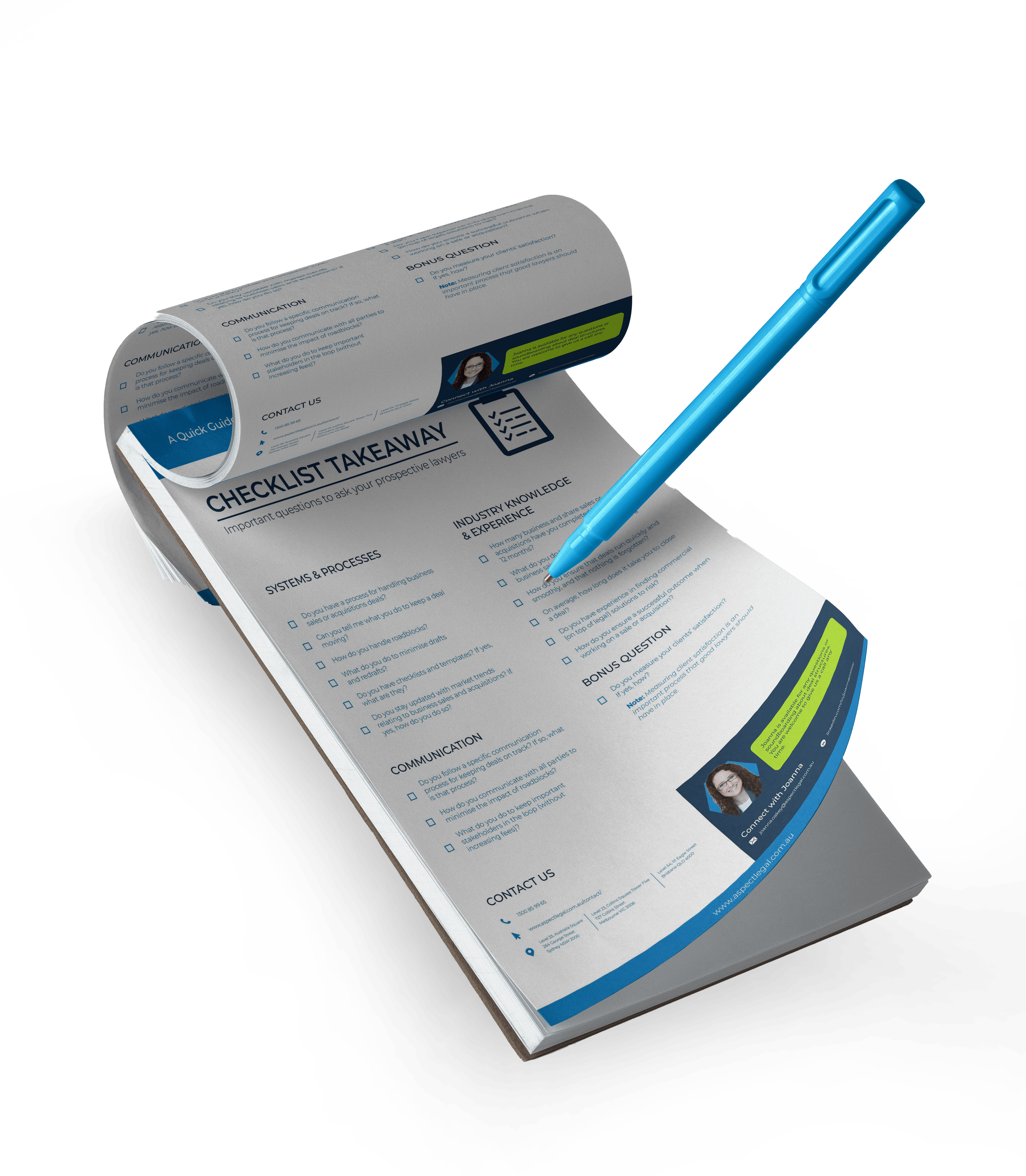
(21:24) Joanna Oakey: Well, that’s it for this episode of The Deal Room Podcast. If you enjoyed this one, make sure you subscribe so you never miss an episode. If you’re a Chinese business looking to invest or operate in Australia, we’ve put together a free guide all about doing business in Australia, covering what you need to know before you start. Grab it via the link in the show notes. And if you’d like to book a call with Sian or the team at Aspect Legal about your own situation, head to aspectlegal.com.au or check the show notes for a direct link. And thanks again for listening in. You’ve been listening to Joanna Oakey and the Deal Room Podcast, a podcast proudly brought to you by our commercial legal practice, Aspect Legal. See you next time.
Disclaimer: The material contained on this website is provided for general information purposes only and does not constitute legal advice. You should not depend upon any information appearing on this website without seeking legal advice. We do not guarantee that the contents of this website will be accurate, complete or up-to-date. Liability limited by a scheme approved under Professional Standards Legislation