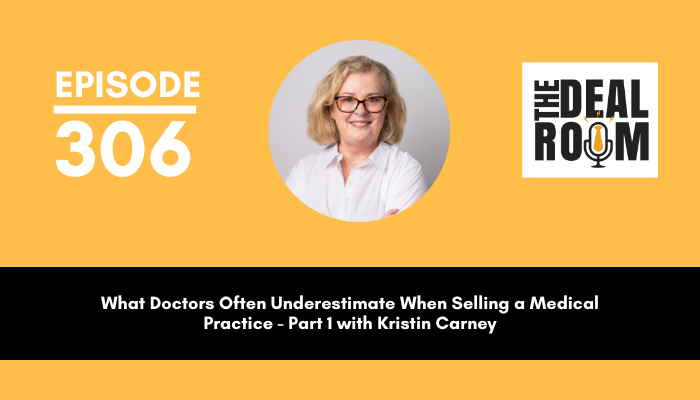
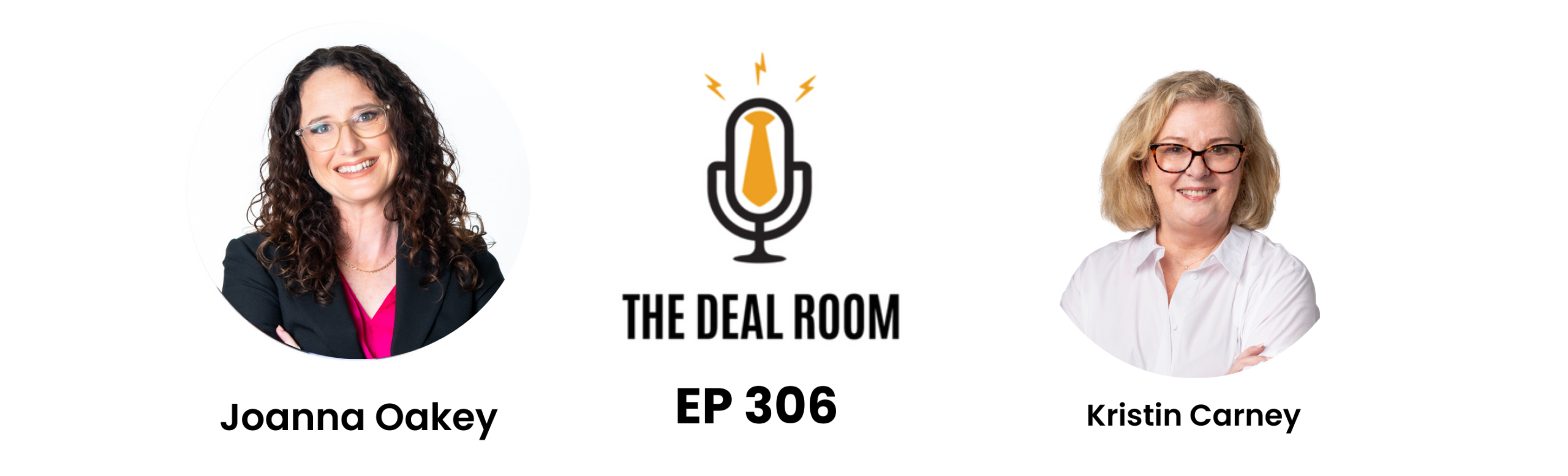
In this episode of The Deal Room Podcast, host Joanna Oakey is joined by Kristin Carney, founder of Piper Health and a trusted advisor to doctors and medical practice owners selling a medical practice or preparing for sale.
In this episode (Part 1 of a 2-part series), they unpack:
- What “sale readiness” really looks like for medical practices
- Why emotional preparation is just as important as financial preparation
- The power imbalance doctors often face when negotiating with large corporates
- How forensic due diligence can derail momentum if sellers aren’t prepared
- Why having an experienced advocate can change both the outcome and the experience
This conversation is essential listening for medical practice owners thinking about selling, and for advisors supporting clients through high-stakes transactions. It offers a grounded, real-world look at how preparation, empathy and clarity can make the difference between a sale that feels exhausting — and one that feels like the right decision.
Don’t miss this practical and insightful discussion — tune in now on The Deal Room Podcast.
ABOUT KRISTIN CARNEY
Kristin Carney is the founder of Piper Health and a highly regarded advisor to medical practice owners navigating sales to large corporate buyers. Her background spans nursing, practice management and senior leadership roles within corporate healthcare, giving her a rare perspective from both sides of complex transactions.
Kristin has advised on more than 200 successful medical practice sales, with deal sizes ranging from $250K to $20M.
Connect with Kristin Carney:
- Linkedin page: https://www.linkedin.com/in/kristin-carney-1445a11a9/
- Email: [email protected]
- Contact Number: 0421 586 887
ABOUT PIPER HEALTH
Piper Health is a boutique healthcare advisory specialising in medical practice sales and transitions. The firm advocates exclusively for sellers, focusing on efficient strategies to maximise practice value while ensuring the right cultural and values fit for both sellers and buyers.
With decades of clinical and corporate healthcare experience, Piper Health supports doctors from early planning through to completion.
- Learn more at www.piperhealth.com.au and book a complimentary discovery call to discuss transition plans.
00:19 Welcome & episode overview
01:05 Kristin Carney’s background in healthcare
02:30 Working on both sides of the table
03:25 Why doctors need an advocate when selling
05:28 Protecting legacy, culture and practice values
06:38 Power imbalances with corporate buyers
07:46 The intimidation factor in negotiations
09:19 Translating corporate language for doctors
11:56 What corporates really want (and what’s negotiable)
12:52 The reality of forensic due diligence
14:30 Why most practices aren’t sale-ready
17:55 Setting timelines and managing momentum
19:43 Knowing when a buyer isn’t serious
21:43 Emotion and identity in selling a life’s work
22:43 Wrapping up Part 1
Introduction (00:00):
Ladies and gentlemen, are you ready? Okay, here we go. You’re listening to the Deal Room podcast. Join us as we bring you the inside scoop on business sales and acquisitions. Get across trends in the area and hear the industry’s best recount their real life tips, traps and experiences. Now, here’s your host, Joanna Oakey.
Joanna Oakey (00:32):
Hi, it’s Joanna Oakey here and welcome back to the Deal Room podcast, a podcast proudly brought to you by our commercial legal practice, Aspect Legal.
Now in this episode, I’m talking with Kristin Carney, founder of Piper Health, all about how doctors and medical practice owners can prepare their practices and themselves for a successful sale.
With more than four decades of experience in healthcare from nursing and practice management through leadership roles at OCA Health, Genesis Care and Blackmores Limited, Kristin has advised on more than 200 successful transactions, helping practice owners get ready to sell both financially and emotionally.
And in this episode, Kristin and I talk about what sale readiness really looks like for medical practices, how to navigate due diligence without losing momentum or confidence, and why emotional preparation is just as important as financial preparation.
So let’s jump in.
Joanna Oakey (01:29):
Kristin, I just want to say a huge thank you for joining us on the Deal Room podcast today.
Kristin Carney (01:34):
Thanks, Joanna. It’s a real privilege. I’m most excited to receive the invitation. So let’s enjoy the next half hour.
Joanna Oakey (01:44):
Absolutely. Well, I absolutely know I will because I’ve heard you talk about such interesting things, Kristin, in the past.
And that’s why I wanted you on the podcast, because I think you bring a bit of a unique view.
So where I want to start actually is maybe with a bit of your background. Why don’t you start just talking a little bit about what you do now? You could tell us how you got there and why.
Kristin Carney (02:07):
Look, I live in the very top of the Blue Mountains and that was a bit of a lifestyle change triggered by COVID.
At the same time, I’ve been working in corporations for years and in the healthcare space — general practice, pathology, specialist services — but predominantly in private equity or listed organisations in executive type roles.
I did have a nursing background, which actually put me into healthcare at the start. And over the course of 30-odd years, I’ve always worked with doctors, service provision, professional services, et cetera.
So I run a little advisory whereby I work with doctors who are selling or wanting to sell or planning to sell to large corporations.
And that’s triggered by my background, obviously, because I’ve worked with a number of those big organisations, but on the other side of the desk.
And it was through some professional experience that I really felt there wasn’t a real advocate for doctors in this space to advise them on what it’s like to deal with a large corporation.
Because corporations have got a lot of staff, a lot of very smart people, a lot of time, a lot of money, and a lot of pulling power.
And GPs on the whole have had no experience whatsoever in dealing with people who come from this kind of background.
When it comes to negotiating the sale of their life’s work and wanting to get a good deal, make sure everybody’s protected — their staff, the services they provide, their legacy — sometimes they can get a bit lost along the way.
Kristin Carney (04:29):
It can be quite intimidating when you’re fundamentally a humanitarian rather than somebody who’s commercial.
And that’s what drove me to work on the other side of the table — sitting with the doctor and helping them navigate with their lawyer and accountant to get to that day one under a big corporate umbrella thinking, “It’s been a great day. I’ve made a great decision.”
Rather than practices I’ve seen struggling towards the finish line, being dragged over it, and day one being a day of regret.
You could call me an adviser, an advocate, a consultant — whatever you like — but really it’s about helping them get the best possible outcome.
And that’s not just about money. That’s about culture fit, about making sure the way they want to keep practising medicine is respected, and that the time spent under the new umbrella is another positive step in their professional journey.
Joanna Oakey (06:52):
I love it. I just love your approach.
And obviously it’s fascinating that you come from sitting on the other side of the table and can bring so much insight from that.
Kristin Carney (07:04):
I hope so. Corporations are great in many ways and many of them are doing things really beautifully.
But they are big powerhouses. Some are multinational. They have huge resources.
And it can be intimidating sitting across the table from them sometimes.
Joanna Oakey (07:24):
And I do find that for doctors — or really any small business owner — who hasn’t dealt with large organisations before, this can be the most important transaction of their life.
They’re dealing with a counterparty they don’t really understand, often with teams of people.
They never come alone.
And you can see it on the faces of selling doctors, particularly in regional areas, when they turn up to the airport to collect three or four people in suits.
You can just see it.
Kristin Carney (08:15):
And I see that as part of my role too.
I might say to a corporate, “Please don’t turn up in suits. These people don’t know what EBITDA is. They don’t know what ROI is.”
Please don’t bamboozle them with corporate speak because it’s just not going to fly.
They’ll be embarrassed and leave the meeting thinking, “What was that all about?”
We want to avoid that. Just keep it simple.
Kristin Carney (09:15):
Doctors are incredibly smart people. They’ve built this business as technicians, not as corporate operators.
So they walk into a room having felt confident and suddenly feel like they don’t understand what’s going on.
They feel like people are trying to find holes in everything they’ve done. They want all their accounts, all their information.
Defences go up. Walls go up.
Kristin Carney (11:33):
And it also helps to know what corporations want, but also what you don’t have to give away.
It’s not just hand-holding. It’s knowing what’s negotiable.
And GPs really don’t understand that.
Joanna Oakey (12:05):
You really are the translator between two different languages and modes of operation.
And that’s incredibly valuable.
Joanna Oakey (12:28):
Let’s talk practically about due diligence.
One issue I find is that most practice owners have no idea what is about to hit them when a large organisation conducts forensic due diligence.
It can be exhausting and time-consuming, and often leads to delays in information delivery.
I’d love to hear your experience and how you get ahead of that.
Kristin Carney (13:55):
Most practices when they ring up a corporation and say, “I want to sell,” are not prepared appropriately.
Preparation can take a year or two.
It doesn’t necessarily mean having all your P&Ls and tax returns done, but things like staff entitlements, operational readiness, financial preparation, and having all your ducks in a row.
Only about 10 per cent of calls to a corporation from practices wanting to sell will actually complete.
Often the practice doesn’t meet the criteria or isn’t prepared.
Corporates will usually pay more, but they’ll want a lot more information, and it’s extremely tiring.
Kristin Carney (16:16):
The way I approach it is first asking — are you emotionally ready? Are you aligned if there are multiple owners?
Who is involved? Who is running the process?
I send them a list of what needs to be prepared and I won’t start the process until it’s ready.
Corporates won’t start it either.
I set timelines for both sides and manage expectations.
Kristin Carney (18:27):
There’s also no point in over-preparing.
You see beautiful 25-page glossy information memorandums that corporates won’t read.
It’s about balance. Keeping it flowing. Being transparent. Asking corporates directly if they want it, and if not, what needs to change.
Joanna Oakey (20:51):
I love the way you frame this because there’s so much emotion involved.
This is often their life’s work. Their superannuation.
Having someone in the middle who can make decisions without emotion is so important.
Kristin Carney (21:18):
I do bring empathy to the process for both seller and buyer.
Selling a practice is not like selling real estate.
You’ve got staff, doctors, spouses, families — it’s an emotional minefield.
I try to be calm, pragmatic and empathetic, explaining what’s likely to happen and what needs to be done.
Joanna Oakey (22:10):
Love it. Love it.
Disclaimer:The material contained on this website is provided for general information purposes only and does not constitute legal advice. You should not depend upon any information appearing on this website without seeking legal advice. We do not guarantee that the contents of this website will be accurate, complete or up-to-date. Liability limited by a scheme approved under Professional Standards Legislation