
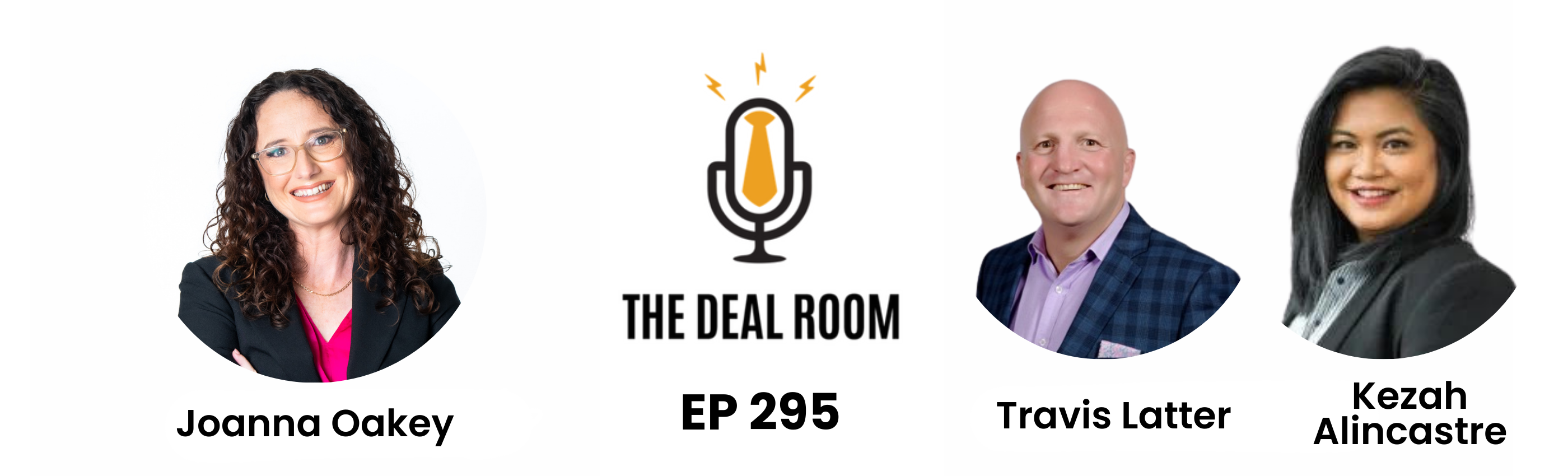
In this episode of The Deal Room Podcast, Joanna answers questions from two of our guests, RTO Investment Strategist, Travis Latter and Director at James Noble Accountants, Kezah Alincastre.
This short sharp Ask Me Anything episode covers:
- Whitewash Explained: Travis brings a fascinating discussion on the increasing requirement for whitewashes in RTO transactions. What is a whitewash, and why has it become a trend? Joanna simplifies the concept, highlighting its significance and the challenges it presents.
- The Rise of Share Sales: Kezah discusses the growing trend of share sales and the legal standpoints that come with them. Joanna provides insight into how risks can be mitigated in these transactions, with a focus on the importance of robust contracts.
- Navigating Minority Shareholding: Kezah also explores the dynamics of minor shareholders, particularly when junior vets buy into a practice. Joanna emphasizes the necessity of shareholder agreements and strategic planning to ensure smooth transitions and happy stakeholders.
Whether you’re a seasoned professional or just dipping your toes into the world of business sales and acquisitions, this episode is packed with valuable insights to inform and enhance your understanding – particularly when it comes to share purchases.
Tune in to The Deal Room now.
P.s. if you missed either Travis or Kezah’s recent Deal Room episodes you can find them here (Ep 291 with Travis) or here (EP 292 with Kezah)
Don’t forget – we’re always looking for questions to answer, get in touch with our team at [email protected]!
ABOUT TRAVIS LATTER
With over $140 million in RTO sales and 24 years of experience in the education sector, Travis Latter is a specialist business broker with a wealth of knowledge of the RTO industry. He has owned his own RTO, held CEO roles with National and International Training Organisations, was an Acquisitions Manager for an ASX listed company, and has consulted to over 250 RTOs and Training Organisations. To date, he has successfully brokered over 123 successful transactions and counting.
Connect With Travis:
Connect with Travis (https://www.linkedin.com/in/travislatter/)
ABOUT INFINITY BUSINESS BROKERS
Infinity Business Brokers are highly experienced specialists in RTO Sales, Acquisitions and Mergers and Australia’s leading RTO sales authority.
Find out more about Infinity Business Brokers. (https://infinitybusinessbrokers.com.au/)
ABOUT KEZAH ALINCASTRE
Kezah is a qualified Chartered Accountant with a Bachelor of Commerce degree in Accounting and Finance and more than 12 years industry experience. She helps business owners navigate the complexities of succession planning, share sales, and tax compliance (and more) and has particular expertise in providing financial and tax advice tailored to the veterinary sector.
Connect With Kezah:
Email [email protected]
Linkedin – https://www.linkedin.com/in/kezah-alincastre-32671194/
About James Noble Accountants
Firm Profile
Ask Me Anything with Travis Latter
00:00 Rise of Whitewash in Share Sales
04:28 Understanding Whitewashes in Funding
Ask Me Anything with Kezah Alincastre
07:28 Benefits of Smaller Share Sales
10:38 Balancing Contract Cost and Protection
14:03 Practice Share Sale Succession Strategy
Introduction 00:00:00 – 00:00:04
Ladies and gentlemen, good evening. Are you ready?
Okay, here we go.
Introduction 00:00:04 – 00:00:44
You’re listening to the Deal Room podcast. Join us as we bring you the inside scoop on business, sales and acquisitions. Get across trends in the area and hear the industry’s best recount their real life tips, traps and experiences. Now here’s your host, Joanna Okey. Hi, it’s Joanna Oakey here and welcome back to the Deal Room Podcast, a podcast proudly brought to you by our commercial legal practise, Aspect Legal. Now, today we’re stirring things up a bit with another of our special segments. It’s time for another thrilling episode of Ask Me Anything.
Joanna Oakey 00:00:45 – 00:01:38
Now, if you’re new to the Deal Room podcast, let me give you a quick rundown. Our Ask Me Anything segment is where I dive into the questions that you’ve our incredible listeners send in. And not just your questions, we also feature queries from our fabulous guests and those interesting nuggets we encounter during our day to day practise. So here’s your chance to have your burning questions answered. Email us @podcastpectlegal.com we’re eagerly awaiting your queries and don’t worry, you’ll find the link in the show notes to that for easy access as well. So look, don’t hold back. We’re open to talking about anything and everything on this podcast. So buckle in because it’s time for another thrilling edition of Ask Me Anything.
Joanna Oakey 00:01:39 – 00:01:52
And Travis, welcome in. You are in an Ask Me Anything where we flip the tables here and you ask me something and I’d just hike to hell that I can answer it and if I know it doesn’t matter, I can edit it out.
Travis Latter 00:01:54 – 00:02:20
All right, Joanna, so in RTO transactions at the moment, anything that’s involving a bank seems to have to go through a whitewash and the banks are insisting on it regardless of the deal size. I’ve got a deal at 150,000 where the bank is wanting to have a whitewash. Can you explain what a whitewash is, what other terms it’s called? And just a little bit about how it.
Joanna Oakey 00:02:20 – 00:03:10
Yeah, I’ll just, I’ll give it really simple and high level because it’s one of those things that really is like, it’s fascinating actually. I reckon sort of 10 years ago this was like, it almost never happened in the market with funders requiring this whitewash process. And it really is a function. We’ve seen it around the last, probably the last six or seven years, but particularly so in the last 12 months as we’ve seen quite a few quite A few funders getting on board this exciting train of requiring a whitewash. So what a whitewash is this. Usually it is triggered in a share sale environment. So it impacts share sale, not business sale. And of course does anyone who’s in the RTO industry knows that in buying and selling we have to transact by way shares up.
Joanna Oakey 00:03:10 – 00:04:28
No matter what the size of, of the deal, we’re in a share sale rather than a business sale. So this becomes particularly relevant in this industry. But, but wherever we have a share sale where the buyer is getting funding for the acquisition and part of the funding requires that the target company so the company whose shares that are being sold is being used as security by the bank or the funder for the loan, then we have a situation that is a quick recall breach of the Corporations Act. So technical beach of breach of the Corporations act doesn’t sound good for anyone. There’s a provision in the Corporations act where we can deal with that by doing what’s called a whitewash. And a whitewash is just the boring process of, of having a few forums, an information memorandum, some ASIC for having to call a general meeting of, of the shareholders of the company to approve the financial assistance and then assets essentially rubber stamping it once the, once the forums have gone off to them. The problem however, as you will very well be aware Travis, is it’s not so much the paper pushing that happens, it’s more the time frames and the fact that. And I guess the.
Joanna Oakey 00:04:28 – 00:05:43
So the good and bad thing in this industry is that we usually have this long period of time between exchange and completion anyway as we are waiting for our approvals to come through before completion. So it gives us time to do the whitewash. The problem is quite often buyers don’t realise this might be triggered as part of the funding and so it just triggers a whole heap of complexity. I just, I really think whitewashes are a bit. The whole concept and the whole requirement, the whole technical breach of the Corporations act between. You mean the gate post and I guess this is public, so everyone else that’s listening to it seems like a bit of waste of time and energy, but it’s something that these days just has to be done and most funders are requiring it in these sort of, in these circumstances and we are in the situation where really if you’re a buyer you’ve got to be aware of it because if you’re not aware of it you’re going to end up with this being landed on your lap at the last minute and then Potentially if it’s not right until the end where we’re close to completion, it can really hold completion up. There you go. That’s the quick for 101 on whitewashes.
Joanna Oakey 00:05:43 – 00:05:58
But it is fascinating. What are you seeing? Obviously you see share sales in every transaction that you deal with. Are you finding through that it used to be that it was very rare and now it’s turned into something that’s far more common.
Travis Latter 00:05:58 – 00:06:25
Yeah, I think I’ve got five going through at the moment that have got funding and four of them have had whitewash. And then. But the fifth one I’ve said to the. I’ve said to the buyer, expect this to happen. No, we haven’t been told that. And it’s even to the point where make sure you’ve got the. We’ve got to have the contract in place because the bank, before they approve your finance will want to see the contract on. Oh, they haven’t told us that.
Travis Latter 00:06:25 – 00:06:43
So I think the banks are still working out how to communicate something that actually has no fundamental change. That’s a requirement. It’s as you said, it seems like a step that they’ve put in because it’s a flavour of the month but it doesn’t actually do anything for the buyer or the vendor.
Joanna Oakey 00:06:43 – 00:06:51
It does seem to be a bit of a pointless exercise, but an exercise nonetheless that we do. Yeah. Thank you, Travis.
Travis Latter 00:06:52 – 00:06:54
Thank you, Jo. I appreciate your time. Jo.
Joanna Oakey 00:06:54 – 00:06:56
Okay. What have you got to ask me? Keza.
Kezah Alincastre 00:06:57 – 00:07:10
All right, look, I. We’ve been talking about share sales. We’ve been talking about how that’s becoming a little bit more common. Do you find that it’s becoming a little bit more common share sales from a legal standpoint?
Kezah Alincastre 00:07:10 – 00:07:10
A lot.
Kezah Alincastre 00:07:10 – 00:07:28
There’s this huge misconception about buying into a company, obviously legacy companies, I understand something that’s been there for 20 years and buying into that is quite a daunting thought perhaps for some, for some buyers. From a legal standpoint, how do you think this risks get mitigated?
Joanna Oakey 00:07:28 – 00:08:49
Yeah, yeah. And it’s a really important discussion point because there are. We do deal with a lot of share sale agreements so we, we deal with mid market matters and we also deal with smaller matters like the sub 1 and $2 million space share sale used be the bigger deals and that would be really quite regular because it shares sale actually does have a lot of benefits for a buyer, the larger the business. But now we see it like very regularly even in the smaller deal space. So it’s really interesting because we’ve had to build this sort of toolkit of how we talk about share sales with a buyer, particularly when we’re asking for a seller and there’s tax reasons for a share sale and to talk to a buyer about why it’s a positive thing for them. And of course, if we act for buyers, we have to be able to help them understand whether it’s a good idea to transact by waiver share sale or not. One of the benefits for a buyer of transacting by way of a share sale rather than a business sale is that there is a less disruption to the assets of the business. Because when you’re in a business, essentially what you have to do is pull each of the single assets out.
Joanna Oakey 00:08:49 – 00:09:44
You may not realise that’s what’s happening, but that’s what’s happening. You’re transferring all the assets from one business to another business, or one company to another company, one entity to another entity. And what that means in practise is that you are, for a veterinary practise, you’re signing, you’re moving your suppliers over to a new entity. It means you’re moving the lease, so the premises over to a new entity. And that might have a whole heap of issues in itself in relation to getting landlord consent for that. So you essentially are dealing or moving all of the assets, you’re moving the employees as well from one entity to another. So the benefit of a share. So you’re not doing any of that, all you’re doing is purchasing the shares, you’re not moving anything, so it doesn’t disturb the asset, it doesn’t even disturb the employees.
Joanna Oakey 00:09:44 – 00:10:38
For veterinary practise, there’s probably not a lot of disturbing of the. Of the clients, because in veterinary practises, usually we don’t have this issue of so much of transferring client contracts, as an example, because that’s not really the way the business usually operates. But you do have all of the other assets that. That you have to look at. When we have buyers coming in, we’ll talk to them about what the mechanics will be for them actually getting the assets into another business. And if that’s a bit tricky, we might talk to them about the benefits of them being the driver of a share sale rather than a business sale. But on the flip side, the smaller the business, certainly there is risk in, in. In transacting by way of a share sale because you’re getting the skeletons of the history of that, of that company.
Joanna Oakey 00:10:38 – 00:11:26
And in, for example, any mistakes that they’ve made in the tax returns in the past or whatever, we can deal with that through the contract. So we deal with that in the share sale agreement and we deal with that by what we call warranties. So they promises by the seller that the accounts and the information that they’ve provided in relation to the business is accurate and there’s no claims and there’ll be no issues if there’s a tax audit and all of those sorts of things. But the smaller the transaction, the less money people want to spend on paying for a robust contract. Right. So here you have a bit of an issue. You need a robust contract in order to protect you as a buyer in a share sale environment for those risks. But the lower the transaction value, the less you really want to pay.
Joanna Oakey 00:11:26 – 00:12:08
So here’s our bit of an issue here. And ultimately, I guess that sort of explains why in transactions, the smaller they are, the less likely they are to be a share sale and the larger they are, the more likely they are to be a share sale because the higher transaction costs and concepts to deal with are worth it in return for the value of the asset that they’re dealing with. And even from a buyer perspective, getting some of those benefits of preserving the assets if there might be a risk of leakage of assets because you’re having to move them in a business sale environment. So there you go. I feel like that was a long answer.
Kezah Alincastre 00:12:08 – 00:12:09
No, it was great.
Joanna Oakey 00:12:09 – 00:12:10
Simple question.
Kezah Alincastre 00:12:11 – 00:12:15
No, that was great. I do have another question, if that’s okay.
Joanna Oakey 00:12:15 – 00:12:21
Love that. Go for it, Kev. Minus. Indeed. And ask me anything. Yes.
Kezah Alincastre 00:12:21 – 00:12:47
So with share sales we find as well, especially with junior junior vets buying in, that maybe buying in a hundred percent is a little bit too much for the moment. So they could probably just afforder is open to buying 20%, 25%, which then puts them into a minor shareholder space. How do you navigate catering to or making sure that minor shareholders are happy, especially when they’re buying into a practise?
Joanna Oakey 00:12:47 – 00:14:03
Yeah, it’s a really good question. It’s really interesting because I, I think it’s a great, it’s a really great way to deal with the, the succession or the exit of, of a vet practise to be able to sell it to vets who are already in the practise and know the practise because one of the things in, in a, in a business sale or a share sale environment, when you’re selling to a third party, you’re always having to build bridge this trust gap because the buyer coming in doesn’t know the business, they don’t know the practise, they don’t know the way the practise runs. And so there’s this whole process which we call due diligence, which is the buyer getting to understand the business. That whole. That whole process is just a lot easier when you’re dealing with people who are in the practise who know how the practise operates. And whilst they may not know the practise intimately in terms of its financials during their period of employment with the practise, they do know how the practise works and operates. So there’s all the benefits of it. But on the flip side, the issue, of course, is that quite often vets in the practise won’t have the funds to do full buyout straight away.
Joanna Oakey 00:14:03 – 00:16:13
And that’s why we often have this situation where they’ll buy in parcels over time. So when we are acting for vets who are selling or buying, in that instance, there’s a lot of things for us to think about. The first thing is, for that period of time that you’re both holding shares together, you’re in this business relationship together, so we need to make sure we have guidance around that business relationship in the form of a shareholders agreement or some sort of, depending on what the structure is, whatever the corollary of that is, but essentially a document that sets out your understanding about how decision making will occur, what happens if you don’t agree, what happens in those situations, and also, very importantly, exit at the end, because the. Usually you’re in the situation where the incoming vet wants to be able to potentially purchase the rest of the shares over a period of time, and usually you’re in the situation where. Where the selling vet, so the founder, the person who is running the practise or owning the practise, is wanting to ultimately exit over time. So you’ve got those two interests that essentially are very similar interests, but you have to work out how to navigate that, because sometimes, whilst you might be on the same page, and you should have that discussion right up front, like, what is that timing? What are the milestones? What are we looking at in terms of when the rest of the sale will occur, what might be a trigger for that and how we will value the practise at the point of that ultimate exit. And I think it’s super important to have these discussions early on in order to avoid dispute later on, and we should have real clarity about what the trigger point is for further sales. So it might be further sales in tranches, you might even agree right now about what that future sale will look like, when the future parcels of shares will be sold for and what value they’ll be sold for, or what formula will be used to come up with that sale value.
Joanna Oakey 00:16:13 – 00:16:54
Or you might instead build it by way of options. And options can work either way where either the buyer has the right to force the seller to sell, or it can be the flipway where the seller has the right to force the buyer or the minority holder or the vet coming in to purchase the rest of their shares. So there’s heaps and heaps of things to think about in that situation. But I just like to be absolutely clear, it doesn’t have to be hard. It’s just you need to make sure you’ve got that checklist of things that you’re thinking about. You’ve got someone to hold your hand and tell you what’s normal and what you do. And quite often that’s what happens. Actually.
Joanna Oakey 00:16:54 – 00:17:29
People quite often will have vets come to us or whatever the industry might be, and we’ll sit down and they say, what are the things to consider? And we work through that whole list and then they’ll get to the end and we’ll say, okay, we’ll give you a checklist so you can go and have you think about it. And then they go, okay, just tell us, what does everyone else do? Because like, it was quite hard to work through some of this stuff, but it doesn’t have to be hard. But what is harder is if you don’t work it out right now and you leave it to down the track and at that point you realise you’re not on the same page. Now that is particularly difficult.
Kezah Alincastre 00:17:29 – 00:17:34
That’s right. And that’s why it’s important to have shareholder agreements 100%.
Joanna Oakey 00:17:35 – 00:17:41
Absolutely. Yeah. Love it, love it. That’s good. Great questions. Thank you very much.
Kezah Alincastre00:17:41 – 00:17:42
Great, thank you.
Joanna Oakey 00:17:43 – 00:18:44
Well, that’s it for our Ask Me Anything episode today. I hope you found that useful. Now, we’ve got a few more of these style podcasts coming up soon. I find it invaluable to be able to answer these top of mind questions, whether they’re from our guests, our audience or our client. Now, if you have a specific topic or question that you’d like us to discuss, then submit your Ask Me anything questions to podcastpectlegal.com or check out the show notes to this episode where we will link right through to an email for you to submit to Submit your Ask Me Anything questions. And an important reminder that if you would like any legal assistance with matters that you’re working on at the moment. Then don’t forget, you can book in for an initial free call directly with our legal Legals at Aspect Legal by heading to our [email protected]. well, that’s it for me today.
Joanna Oakey 00:18:44 – 00:18:55
My name is Joanna Oakey and you’ve been listening to another wonderful episode of our podcast, proudly brought to you by our commercial legal practise, Aspect Legal. See you next time.
Disclaimer:The material contained on this website is provided for general information purposes only and does not constitute legal advice. You should not depend upon any information appearing on this website without seeking legal advice. We do not guarantee that the contents of this website will be accurate, complete or up-to-date. Liability limited by a scheme approved under Professional Standards Legislation