Podcast: Download ()
Get notified of new episodes: RSS
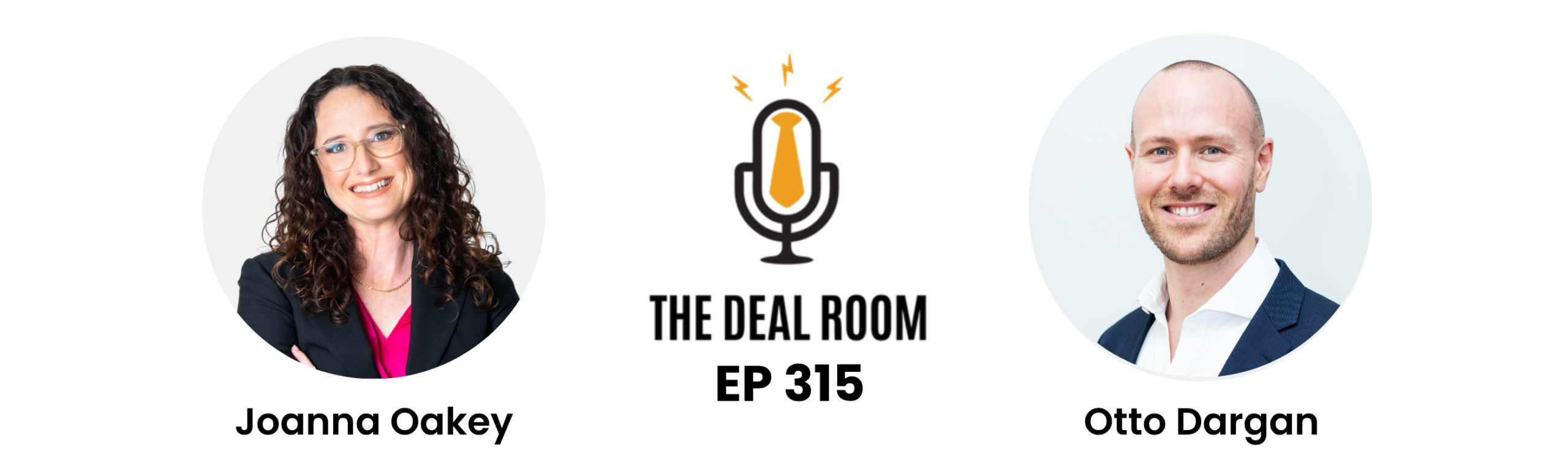
This episode of The Deal Room Podcast looks at how AI is already changing business valuation. Otto Dargan, founder of Home Loan Experts, joins Joanna Oakey to unpack the AI mistakes he made scaling his own team, the buyer red flags to watch for, and the minimum AI-ready standard before you sell or buy a business.
In this episode of The Deal Room Podcast (Part 1 of 2), Joanna Oakey is joined by Otto Dargan, founder and CEO of Home Loan Experts, one of Australia’s leading specialist mortgage brokerages.
Otto has built a team of around 328 people across Sydney and Kathmandu, and describes his own business as a research lab disguised as a mortgage broker.
In this episode, they unpack:
- The biggest mistake Otto made bringing his own team onto the AI journey
- Why chasing cost cuts is often the wrong AI question to ask first
- How AI is changing business valuation and the way buyers and lenders assess a business
- The difference between AI-native startups and legacy businesses layering AI on top
- The warning signs buyers should look for if a competitor’s AI release could catch a target off guard
- Why a team fluent in AI has become a genuine moat, and what to build first if yours isn’t
Otto and Joanna get into a live question for anyone buying or selling right now: whether AI actually changes what a business is worth, or just widens the gap between the businesses that are ready for it and the ones that aren’t.
This conversation is essential listening for business owners thinking about selling in the next few years, and for buyers wanting to price AI upside into their next acquisition. Otto and Joanna move quickly through what’s actually changing in valuations and due diligence right now.
Catch Part 2 with Otto Dargan soon, where Joanna and Otto get into the financing and acquisition side of his business.
ABOUT OTTO DARGAN
Otto Dargan is the founder and CEO of Home Loan Experts, one of Australia’s leading specialist mortgage brokerages. He began his career as a mortgage broker at 18 and founded the business in 2006, building it into a team of around 328 people across Sydney and Kathmandu, including Alaya, the group’s Nepal-based outsourcing operation. Home Loan Experts is known for solving complex loan scenarios that other brokers and banks don’t have the experience to handle, and has settled more than $8 billion in home loans.
A 2 time winner of St George and The Adviser’s Australia’s Brightest Broker competition, Otto has spent 2 decades working across every part of the business, from credit and compliance to marketing and operations. He is now focused on transforming the company into an AI native organisation, using AI agents and internal training programs to reshape how mortgage broking and outsourcing work is done.
Connect with Otto Dargan:
- LinkedIn: linkedin.com/in/otto-dargan-2ab9a74
- For home loans, business acquisition financing, investment loans: homeloanexperts.com.au.
Episode Highlights
0:00 – Intro
1:16 – Otto’s biggest early mistakes with AI, and bringing his 328-person team along
4:39 – Inside Home Loan Experts: “a research lab disguised as a mortgage broker”
7:57 – The gap between AI-ready businesses and everyone else
9:42 – Why efficiency isn’t just cost cutting
11:20 – Why automating tasks is harder than most people think
15:47 – AI and the workforce: lifting your star performers
17:35 – How AI is changing business valuation: the new risk buyers and lenders price in
19:18 – The minimum standard: why your business should be AI ready before you sell, and what due diligence looks for
20:42 – Buying a legacy business and layering AI on top
22:38 – Due diligence: will this business survive the AI revolution?
25:12 – The opportunity for buyers in older, owner-run businesses
29:39 – Which businesses will be priced out, and why a team fluent in AI is a moat
31:17 – Email automation and why it’s the CEO’s best use case
33:36 – Metacognition: teaching AI how you think
35:29 – Where to start: building the team that builds the system
37:38 – Otto’s closing thoughts
39:08 – How to find Home Loan Experts and the free AI deal readiness advisor
40:45 – Outro
FREQUENTLY ASKED QUESTIONS (FAQs)
Q1: Does AI actually change your business valuation?
Otto Dargan says buyers and lenders are now weighing new risks before they price a business, like whether a competitor’s AI could catch it off guard, and whether its cash flow and growth can hold up. That’s shifting the traditional valuation model for many businesses closer to how a technology startup gets priced.
Q2: What should buyers look for before acquiring a business right now?
Otto suggests picturing this: if a competitor released an incredible AI system tomorrow, would the business survive? That points buyers toward what AI cannot replace, like a genuine brand and real relationships, and toward where AI could make the business meaningfully more efficient.
Q3: How is AI changing due diligence in business sales?
Otto says AI can review all the documents in a deal and spot things a human might not, and he thinks cyber security is probably one of the first things buyers look at in due diligence. He says the minimum standard now is a business being AI-ready, with trained staff, accessible AI tools, and proper guardrails in place.
Q4: What’s the difference between an AI-native startup and a legacy business using AI?
Otto explains AI-native startups try to run with very few staff and let AI do almost everything. Legacy businesses carry more complexity, but they also have an established brand, an existing team, and real customer data, advantages a new AI-native startup doesn’t have yet.
Q5: Why does Otto Dargan say a team fluent in AI is a moat?
He compares a team that isn’t fluent in AI to a CEO in 1999 who refuses to get an email account, not a good position once the world has changed. Building that fluency starts with the right people, he says, including a CTO and a board aligned on where the business is headed.
Q6: What’s the biggest AI mistake Otto Dargan made in his own business?
Otto says his biggest early mistake was assuming his team would grasp where AI was heading as fast as he did. People using what looked like a simple chatbot struggled to see the scale of what was coming, so bringing the whole team along mattered more than moving fast alone.
Q7: Is cutting costs the right way to think about using AI in a business?
No, Otto says that’s often the wrong first question. He points to using AI to strengthen other parts of a business instead, building an advantage that keeps paying off for years, rather than measuring AI only by how many roles it can remove.
Note: this transcript was generated automatically, so it will contain errors. It’s here as an easy way to scan for anything relevant to you, not as a word-perfect record of the episode.
(0:00) Announcer: Ladies and gentlemen, Good evening. Are you ready? Okay, here we go. You’re listening to The Deal Room Podcast. Join us as we bring you the inside scoop on business sales and acquisitions. Get across trends in the area and hear the industry’s best
(0:24) Joanna Oakey: Hi, it’s Joanna Oakey, and welcome back to the Deal Room Podcast, a podcast proudly brought to you by our commercial legal practice, Aspect Legal. In this episode, I’m talking with Otto Dargan, founder and CEO of Home Loan Experts, about the widening gap between AI-ready businesses and everyone else. And we cover why that gap is starting to show up in how buyers value a business, what buyers now check for in due diligence before they’ll call a business AI ready, and how Otto runs AI inside his own 328-person business. There’s a lot to get through, so let’s dive in. Otto, thank you so much for joining us on the Deal Room podcast. It is such a pleasure to have you on the show.
(1:12) Otto Dargan: And great to see you, and pleasure to be here.
(1:16) Joanna Oakey: Fantastic. Okay, all right. So why don’t we kick it off with a bit of a background, Otto. So, you have got such an amazing AI transformation story. 328 people in your team. Australia, Nepal. What did you get wrong first in AI?
(1:35) Otto Dargan: Oh, many things. I would say probably the biggest early mistake was about bringing the team on the journey. I could see what was coming, but it was really hard to get people that are using what appears to be a very simple chatbot that makes a lot of mistakes and see where this is going. And so I wanted to move fast and go, okay, there’s a lot happening here. But a lot of my team didn’t understand the implications of where this would go.
(2:09) Joanna Oakey: And what do you mean by that? What do you mean the implications of where this would go?
(2:14) Otto Dargan: Well, when you look at the amount of money that California has spent, right, and other parts of the world, and you look at the geopolitical pressure from like China and the USA, effectively any problem standing in the way of creating more intelligence is just going to get a fire hose of resources, the smartest people, truckloads of money. And so, what that means is that I don’t think we can really stop it getting a lot better than it is today. And the question is then what does that mean for business owners, for employees, and generally for the world? It’s an unknown situation with many potential outcomes and quite a lot of chaos, very likely.
(3:09) Joanna Oakey: Yeah. Well, it’s an interesting, and there’s a few things I’d like to pick up there, but it’s an interesting question because I have this discussion a lot. And, you know, I hear, like, you and I are both, you know, AI first, AI forward, but there is a lot of discussion about the risks and the issues that AI is bringing to the fore. Having said that, I’ve got no combined. Personal opinion is I’ve got no control about that. All I’ve got control of is how forward-thinking we are and how far ahead of the curve we are of the rest of the people in our industry and in our area. That’s my personal approach. What’s your response to it?
(3:52) Otto Dargan: I think that humanity has a way of kind of like being the student that studies at 3 a.m. when the exam is at 9 a.m. So it’s been a while. We, global warming, you know, various things. We tend to, you see there’s like this capitalist race happening to like create the most powerful AI possible, right? And then if it’s starting to get dangerous, then that’s when we’ll see potentially some cooperation, which is actually what our species needs to do at this stage. We’re not particularly good at it, though. But when crises start to happen, that’s when you might see it. That’s my view anyway.
(4:39) Joanna Oakey: Yeah. Well, we’re going very deep, Otto, but how about we come back to the practical in your business? Walk me through your business and how you’ve applied AI and how it works. I’ve seen a quote from you once that says, your business is a research lab disguised as a mortgage broker. I love that because I feel like we are that to law and to business sell and acquisitions as well. But talk me through what that means. I love that as a line.
(5:08) Otto Dargan: Yeah, we are not a normal business. And I have no interest in being a normal business. So I was actually planning to be a geneticist, like I was going to be a scientist. And I decided that it was actually pretty rough working in science. And so I ended up in finance. And then later when just a holiday trekking in Nepal, I hired some people because I met some smart people. And now I speak Nepali. And most of my team is in Nepal. So we have like 300 in Nepal and 30 in Sydney. And our Nepal team is the back office for a lot of the top mortgage brokers in Australia So Kathmandu now processes
(5:57) Otto Dargan: At least $10 billion in mortgages each year for Australia And so life has taken a very interesting path What that means for when AI comes is that I needed to transform my team in Nepal to be ready for the AI economy. And naturally, I had no idea how to do that, right? And I think no one knew how to do that. And so I kind of shifted back to my science background and started experimenting and exploring and trying different things. Because when there’s new technology, no one really knows how to use it. There’s how we’re told how to use it, but then actually how it ends up being used can often be quite different. So if you look at like when the steam engine was invented, no one knew that would turn into trains and factories and later the internal combustion engine and all sorts of things. And so we’re kind of at the steam engine stage. So that’s why I kind of went for a research approach.
(7:03) Otto Dargan: And, um, so that was, uh, like most of 2025 was tiny, tiny, fast experiments. And, um, that when you do that, you encounter the real problems and you encounter where the real value is. And you also can kind of like kind of fact check California a bit, like what’s hype, what’s fear, you know, what’s noise, what’s signal. And so that was quite a journey. So technically, we’re a mortgage broker, but not really.
(7:39) Joanna Oakey: Well, you do, I guess your revenue is mortgage broking, but you sort of have this research engine lab, as you call it, which I love the terminology for. That’s what I feel like in the background. I must say, every day I come in saying I feel like I’ve turned into a mad inventor.
(7:57) Joanna Oakey: But this is the thing, right? All of the things, you know, people who have ideas, you know, like there’s almost nothing constraining us now, which is a positive and perhaps also has a flip side. But anyway, we’ll get to that later. But talk to me in practical terms, like what efficiency is. And I’ll tell you why I’m asking this question, Otto, because I have a lot of these discussions, right? And I think that what I’m seeing at the moment in the market is that there is sort of really two groups that are pulling away from each other, I think, personally.
(8:35) Joanna Oakey: There’s a group who are just… Mad inventors in their inventing, using AI, and their teams who have found real efficiencies, understand how to keep digging for efficiencies and using AI in that way. And then there’s a group who were super excited right in the bidding. They heard all the razzmatazz, but now they’re a bit bored. They’re the group of people who generally still use AI for rewriting emails, writing emails on their behalf, doing research, maybe tinkering it at the edges, but essentially saying, constantly, and this is a question I ask constantly, but what efficiencies does it actually drive? Because they’re not seeing true, they see the time, the void that you can enter into when you’re playing with AI, but not the efficiency gain. So I just, like, I want to bring those two sectors a bit closer again and demonstrate what are the practical efficiencies in your business.
(9:42) Otto Dargan: Yeah. So I think this is a great area because particularly if you’re in M&A, right, with your industry or finance my industry, our industries are, you know, dominated by the spreadsheet, right? Like kind of show me the money. In your case, it’s the value of the business is what your industry is about. And in my case, it’s like, can this person afford a loan, right? And so that’s our framing, right? That’s how we’re viewing this technology. And that’s how CEOs and CFOs are viewing it too. Like if you’re a big company, like you can’t do creative things. You can cut costs, which that generally means people, or you can do a project for compliance but doing anything else is kind of hard. And so actually, my view is, is efficiency gains the right question? Is that even the right target? Is it entirely the wrong thing to focus on initially? And so I believe that actually it’s more useful to look at amplifying different areas of the business with AI.
(10:55) Otto Dargan: Maybe a good example would be like your podcast, right? If you create great AI that helps you create amazing podcasts, you didn’t necessarily get a cost cut there, which is always often the way a CFO will look at things. But you will build leverage that continues for years because of your personal brand and your business brand.
(11:20) Otto Dargan: Automating tasks, it depends on the task, but it’s a lot harder than most people think. If you want to get the efficiency gain there’s um in in a job there’s there’s all these tiny little tasks and they all connect together and often one person’s job is actually far more complicated than people think and there’s all these edge cases where things go wrong and so um to actually get a cost reduction from ai you you have to really look closely understand the job in great detail and you need to find the tiny little tasks that all need to be done and you need to make all of that work. But in addition to that, AI is great at some things and terrible at others, absolutely terrible, right? And so it only needs one of those things, one part of that workflow that where AI is terrible, then there will be problems. And your value from that AI then drops to, you know, 10% of what you were expecting. Does that make sense?
(12:27) Joanna Oakey: It does, but it’s an interesting thing because when I talked about efficiency, I guess you move straight into, well, it’s not necessarily AI, it doesn’t necessarily deliver us cost-cutting. And maybe you jump there because maybe actually it’s a good point that maybe that’s where most people are thinking. So you’re trying to bring them back. That’s right. I, you know, I never see efficiency as cost cutting. And certainly from our own organizational perspective, and it’s a good point to emphasize, I think, particularly we’re about to go on, I’m going to talk to you about AI repricing businesses. But it’s so relevant there because if you say, okay, we’re not after AI for cost-cutting, we’re after AI to help create leverage, brilliant leverage, leverage, insight, higher quality, you know, all of those. And, you know, a revenue line that comes off that rather than a cost-cutting line. Yeah.
(13:30) Otto Dargan: I would say, like, be creative with the use cases. Don’t just think about cutting costs. Like, really, often you don’t know that something that used to be impossible is now easy until you try, right? You know, the first time someone vibe codes a website and they’re like, oh, I didn’t know I can build a website now, right? And um that’s internally how we do all our uh like many of our meetings we vibe code a website for the meeting notes and make it a html slideshow this is a lot more fun and a lot more engaging and uh it’s very simple um and so things like that um uh are like um examples of really common things we’re using it for we’re using it for a very broad variety
(14:23) Otto Dargan: But in terms of cost cutting, a lot of people are looking at the jobs data and they’re kind of wondering, like, actually, where are the gains? Like, everyone was expecting, like, there’d be all these efficiencies and then companies would have higher profits because they’re cutting costs, which generally means removing stuff. And um the data is quite misleading because um what you said about like there’s some people that are using ai a lot you’ve got to look at individual businesses there are there are businesses that have genuinely cut like 50 of their staff or more and have automated like huge numbers of roles um but not very many and so when you look in the data and you look at the averages things like tariffs and all sorts of things are going to have a much bigger effect but if you look on an individual basis and you look for the outliers it’s very clear and so the risk of um mass employment disruption is very real um the timing is unknown uh people and companies are very slow to adopt things, right? Mm-hmm. So the technology’s there, but the companies aren’t. Mm-hmm.
(15:47) Joanna Oakey: Um, it’s, it’s interesting. And I guess I’ll just make one point on, on workforce. As, as I said before, I have never approached it from a cost cutting, but for me, efficiency is about elevating people within their roles to, um, be able to outperform what they could prior to AI. So that’s my own personal approach to it. But, but the interesting thing, my own experience has been, the kind of, I certainly have no intention ever of reducing workforce, but it has changed who is right in our workforce, you know, because I, you know, my experience had been sort of like a mid-level player on your team before versus.
(16:36) Joanna Oakey: You know, a high-level player that maybe there was a two times difference, you know, your star performer would outperform your mid-level performer two times. But now your star performer with AI by their side, I think, outperforms a mid-level employee 20 times over because someone smart, motivated who gets it with AI by their side is incredible. So, I think, like, who we look for these days has really been impacted, not by AI skills, but who has the ability to really take this and run with it. So, it’s sort of a reforming, I think. But I just, I want to get you back to a quote I’ve seen by you. You’ve said AI is quietly repricing businesses. What do you mean by that?
(17:35) Otto Dargan: Yes. So, I think when in M&A, someone is looking at a business or in our industry, when a lender is looking at a business, they’re now considering risk, right? There’s a new risk. Like, could this business be disrupted? Will its future cash flow still be there? And also, what’s the upside? And also can this business handle exponential growth right um and is it geared for that and so what that means is that um the the traditional valuation model of many businesses is kind of shifting to more like of a technology kind of startup kind of model right and it’s not that simple um but um there’s new factors to be considered and um so i think this is in the minds of people when they’re looking at a business um and so if you’re selling a business it’s something then that you need to be mindful of and to consider how that buyer will view ai’s effect on your business and are you the hammer or are you the nail?
(18:49) Joanna Oakey: Yeah. And I just think that is such a good point, Otto. And this is what business owners who are approaching market at the moment, I really don’t think are thinking about. So let’s say you’ve got business owner here, someone who’s listening into the podcast, they’re thinking about selling in the next two to three years, or maybe they’re thinking about buying in the next two or three years. What does this mean for them? What would you suggest?
(19:18) Otto Dargan: I think at the very least, their business should be AI ready, right? For some businesses, they want to disrupt their industry, right, and go all in, right? And, you know, that’s one direction. Right. Um, other people want to be AI fluent and make sure that they’ve got, you know, the right training for their team, the right AI tools accessible, the right guardrails, good data security, because, um, cyber security is, is now a major risk.
(19:53) Joanna Oakey: Yeah.
(19:54) Otto Dargan: Um, and I’m sure in due diligence, that’s probably one of the first things people look at these days. And so getting all of these things sorted out at the very least the business should be AI ready that’s kind of the minimum standard I think to just ignore AI you know obviously for some industries AI has very little impact but I feel like even just at a leadership level like every business has leaders every business has to do its accounts every business has meetings so there’s actually still a lot of use cases for AI in any business, even if you’re, you know, um, in construction or something like that, right. Where maybe there’s less work in front of a computer. Hmm.
(20:42) Joanna Oakey: Love it. Okay. So let’s put our buyer hat on now and say a buyer is looking at a legacy business. A legacy business has customers, brand data. How big is the opportunity to buy it and layer AI on top? Like where’s the quickest efficiency wins that buyers can be thinking about in the first 12 months?
(21:06) Otto Dargan: Yeah. Yeah, so I think like a legacy business versus startup business, right? So when a lot of startups in, say, California at the moment, they’re trying to go AI native from day one, which means basically you don’t have many staff and you try and have AI do everything.
(21:30) Otto Dargan: But if you’re a legacy business I think it’s a different game because generally you’ve got a more complicated business model you’ve got an established brand you’ve got an existing team and so retraining is a big part um you’ve also um so you’ve you’ve got things that an ai native startup doesn’t have you’ve got data customers reputation brand like all these different things and so um those things are your moats right for an ai native startup you’ve got the advantage of not having all these systems to change and people to train but you don’t have a brand you don’t have distribution um you might get a giant you know pot of VC money but um these are still big hurdles to overcome and so the strategy for the two is completely different and for a legacy business the path forward I think would really depend on where the business is at what advantages it has and where it sees its defensible market position in the future
(22:38) Joanna Oakey: Love it okay all right and I guess like thinking about DD now and then also thinking about, you know, buyers coming in, evaluating a business to work out whether they think it’s going to survive the AI revolution. What would you, if you’re coming in to buy a business at the moment, what would you say are the things to look out for? I mean, obviously we talked about the benefit of ensuring the customer’s brand data, whatever, in the last question, but what else? Like what are you really looking out for as warning signals, I guess.
(23:15) Otto Dargan: Yeah, I guess, like, I think there’s a big element of, like, how good is your defense game, right? Because probably in every industry, everyone has some competitors quietly building something amazing, right? Yeah. And so, it’s the competitors that you don’t know are building incredible things
(23:39) Otto Dargan: That maybe next month, one of your competitors releases something that can… Can really affect you right and so when looking at a business um i think um a really good frame of mind to have if i was buying a business would be like let’s say a competitor released an incredible ai system tomorrow how would this business survive in that situation and really what that means is really coming to the things that are more kind of human or the things ai cannot do so um like where the business has a great brand, like AI can’t really create an idea in people’s heads, right? Which that’s really what a brand is. It’s a perception of a company or a person. Ai can’t build relationships and so the does the business have good relationships
(24:37) Otto Dargan: But also i’d be looking at like what does the business have that um either there will be opportunities to leverage with ai um so for example it has great data um or um where there’s opportunities where the business could become way more efficient with ai is that i personal my personal opinion um when you look under the hood of most companies uh they’re kind of held together with duct tape and prayers yeah and um that’s kind of the the reality of a lot of businesses and so there’s a lot of room to just clean things up
(25:12) Joanna Oakey: Yeah but i feel you know and i feel that this is something that’s not talked much about in the market at moment. And I want to bring in that conversation, but it’s the opportunity for buyers, right now to look at businesses and say, you know, like maybe some of these traditional businesses right now have this massive upside that’s not even being looked at. If you come in and you’re able to say, look, here’s a brand with history, credibility, authority. Now I lay an AI over the top, bam, you know.
(25:52) Otto Dargan: I think it’s a huge opportunity, huge, because particularly – There’s a lot of, say, like, businesses owned by, say, people 50 years old and above. And these are the people with, like, the expertise, the relationships, the reputation, right? Like, these really very powerful things.
(26:18) Otto Dargan: But often, they’re looking at this new technology with a mixture of fear and confusion. And they understand that it’s important, but they don’t know what to do. And then you’ve kind of got these young 20-year-old tech gurus that have this tech expertise and a lot of drive, but they don’t have the expertise, the reputation, and all these things. And so I kind of see that there’s kind of this natural partnership there. And that could either be between two different companies. It could be two different founders. It could be uh someone coming in and buying a legacy business as someone’s retiring like what you’re saying um or i think also in the form of a roll-up in various industries i think there’s going to be a lot of consolidation in um like a lot of knowledge-based service industries um over the next few years and so like uh whoever um really creates the great tech experience for that industry,
(27:23) Otto Dargan: Technology creates monopolies. It’s just unfortunately how it is. And what quietly happened is many businesses in the last couple of years are now a technology business. Maybe you thought of yourself as an accountant like two years ago, three years ago. Now you’re an accountant still, but maybe one of your competitors is now thinking that they’re a technology business. That’s a concern.
(27:53) Joanna Oakey: You know, it was fascinating. I just had a thought that hit me that I haven’t actually thought about before, but it’s interesting because I think the old world business, you know, you, I don’t know if you sort of heard the story of McDonald’s, but essentially, you know, the, the talk was about it essentially had become a property business, but that’s the new world here rather than the value being in, you know, acquisition and, you know, the backend being a property business. Now it’s about that the true business is a technology business. And the interesting component of that auto, though, is also what’s also happening for SaaS businesses because we’re seeing SaaS businesses that are true technology, under threat now as well, right? So, I don’t know. It’s a whole, it’s a very exciting but different world we’re looking at.
(28:41) Otto Dargan: Yeah. And everyone kind of used to love the idea of investing in the next tech unicorn, right? But now they’re questioning, is that model defensible if it’s just a piece of software? And there’s a lot of debate around that, and I’m not really sure. But that’s why the defense game, I think, is critical. If there’s a lot of disruption, then your defense game has to be good. You need moats and you need more than one. Okay. And, um, you have to assume that, um, that your moats will be attacked. Okay. And so if you just have one moat and you’re not that different from competitors and you’re not using technology and you, you, I think it’s a very weak position to be in. And I think those businesses will potentially get repriced down.
(29:39) Joanna Oakey: Yeah, yeah. Well, I mean, and yes, there’s going to be a massive amount of that. But this is a big question, though, for buyers, Otto. I think right now it’s how they understand which of the businesses that are going to be priced out. Like that’s the, I think that’s the gap at the moment in the understanding in the buyer market. And there’s no absolute answer, of course, right now. A bit of it is trying to fortune tell, which is a tricky thing right at this moment. You’ve mentioned moat a couple of times. And in some of our discussions before, you’ve talked about the CEO who refused email. Talk us through that concept. Sorry, side note, let’s just break here and edit. It was in my notes. I don’t even know what that is. But can I intro in that way? Does that work? Can you take it from there? Do you know what I’m talking about? I don’t even know what I’m talking about.
(30:38) Otto Dargan: Yeah, yeah, yeah.
(30:39) Joanna Oakey: All right. Unbreak. Go.
(30:43) Otto Dargan: So a team that’s fluent with AI is a moat, you know, whereas like a team that is not fluent with AI, that’s a problem because, you know, you don’t want to be, you know, like it’s 1999 and you’re the CEO that refuses to get an email account, right? Like it’s just not a good position to be in. When the world changes, you have to change with it. And this is something sometimes we don’t like the change, but that’s the playing field and we have to adapt.
(31:17) Joanna Oakey: Yeah, I completely agree, except the only one thing I would say right now, it’s funny, this might actually come full circle. I hate email. I’m sure you hate email too. Everyone who would prefer to be sitting in there creating. Everyone in the world probably hates email. Let’s be honest about it. But um you know i’ve recently um built some great agents so my ea used to manage my emails but now i’ve got agents that manage my emails i try very hard never to look at emails so maybe it’s come full circle maybe i am the ceo who refused email as well but um, in there in the roll around emails.
(31:56) Otto Dargan: Are a great one actually like in terms of can you automate this right like for a ceo or a founder um and i’d imagine in law like there’s a lot of emails that are like very different topics very complicated um often it’s actually doing the job of a founder a ceo or in you know in law, in the case of doing legal work, right? And so, to answer that email is not an easy thing, right? It’s actually doing the job of that person. And, um… If you want to look at creating efficiency, like if you’re actually trying to get to efficiency, again, people are focusing on the email, but the correct thing to do is to never receive the email in the first place.
(32:47) Joanna Oakey: 100%.
(32:48) Otto Dargan: That’s actually where the efficiency is.
(32:51) Joanna Oakey: I love it. I could riff with you all day, even just on the topic of emails. But it is actually email is a very interesting study in how you can work with, you know, your AI partner, whichever LLM you’re using, to build rules around what you do. Because it’s very interesting how we as humans have all of these intuitive rules that we don’t understand ourselves. And I find that’s such an interesting process in working through building any sort of workflow. but it’s unpacking those intuitive rules that we have never even thought about, but that run everything that we do.
(33:36) Otto Dargan: Yeah. And so you’re getting into an area called metacognition, right, which is thinking about thinking. And so when we do a task, there’s all these little thoughts that are happening in our head And we’re even not really aware of it. But if you want to get AI to automate something, you need to get those steps and edge cases and requirements and all of those different things and what objective you’re trying to achieve actually down into a system. And so, when we tell AI to do things, we often don’t give it the information that it needs. And that’s where a lot of people go wrong.
(34:21) Joanna Oakey: Yeah, yeah. And this is, you know, as we started off the conversation talking about this gap between people who are using AI regularly, people who are sort of playing at the fringes. And I think, but I think this is where the gap is becoming now because it takes, sort of a while. And some people are more naturally systems thinkers perhaps than others. And I think it becomes easier for people who think in systems because I feel that that sets AI, your use up with AI a lot easier. But if we’re bringing everything we’re talking about back very practically, for, any organization playing right now, any organization preparing for sale right now, any buyer looking to buy and then add value through AI, there’s a large importance in understanding how you break down what happens in a business, build it into systems in a way that then you can help have AI by your side. But how do you do that, Otto? Just very practically, how did you do that in your business?
(35:29) Otto Dargan: I think firstly, you’ve got to have the right people in the team. So, it begins with you’ve got to build the team that can build the system. And so, you’ve got to look at your existing team and maybe like in law, you might have lawyers in your team, paralegals, all sorts of subject matter experts. But you may be missing that technology competency, right? And, um, you can build, um, simple, like, uh, you know, custom GPTs or cloud projects or skills, um, if you’re a subject matter expert, but if you want to build like a really effective enterprise, uh, system and for something like law, um, you know, there’s a whole bunch of considerations around, you definitely don’t want hallucinations. Um, I love the newspaper stories about lawyers presenting fake precedents and things like that. I know, me too.
(36:28) Joanna Oakey: I do, I do, yes.
(36:30) Otto Dargan: And this is why you need to actually have the people that know what they’re doing to set up the system to stop things like that happening. And so it depends on the scale of the business, but the first thing is get a CTO. And, um, you, you want to, um, I think also you want to make sure that a board of directors is strategically aligned with where you’re going. If you’ve got, um, a bunch of like, um, you know, retired people with Gravitas on your board, that’s very helpful from an experience of risk and many other aspects, but maybe you need some, someone who’s like a tech founder who’s exited, right. Who can then bring that other experience of like, how do you do this technology transformation? So you’ve got to have the board strategically aligned with where you’re going. You’ve got to have the CTO and it’s the CTO’s job to then build the team that you need. I’m guessing as a founder or CEO, you may not know what team you need. And I could tell you what team we need, but that’s not going to help you, right?
(37:38) Joanna Oakey: Love it. Otto, very sadly, we’re out of time. I feel like you and I could talk AI all day. I just think, you know, I guess from my perspective, I think there’s so much opportunity for buyers in the upside of businesses that they’re looking at acquiring, that maybe they’d never thought about pricing in before into the upside or considering as part of their assessment of a target. But for sellers, there’s a lot of a warning there in terms of getting prepared for sale. What are your, like, what’s your synopsis of this market? Like, any lasting words to leave our audience with Otto?
(38:21) Otto Dargan: I think AI changes many parts of buying and selling a business, from the valuation to due diligence. You could just review all the documents and see things that maybe a human couldn’t, to the future of those businesses. And so I think it’s really important that people just be aware of what’s happening and how the game is changing and be aware that everyone’s still figuring it out. Which is an opportunity. If you figure it out before everyone else, then you have information asymmetry and that puts you in a very strong position. That helps.
(39:08) Joanna Oakey: Love it, Otto. Look, and if any of our, we will have a podcast episode for our listeners. We were actually going to drill into the financing side and that’s what your business does, Otto. So maybe, is there a link? How can our listeners find your business if they’re looking to acquire, they want some financing, or are they just going to riff on AI? I don’t know if you riff with people on AI, but anyway.
(39:39) Otto Dargan: So homeloanexperts.com.au. And so we’re mortgage brokers and we can help with acquiring a business, home loans, investment loans. Or if you just want to talk about AI. But really, if you want to complain about the banks, we’d love to hear about that too. We enjoy it immensely.
(39:59) Joanna Oakey: Oh, that’s fantastic. I love it. Thank you so much for coming on to the show.
(40:05) Otto Dargan: And yeah, great to have a chat.
(40:07) Joanna Oakey: Well, that’s it for this episode of the Deal Room podcast. If you enjoyed this one, make sure you subscribe so you never miss an episode. Otto’s put together a free AI deal readiness advisor. Just paste the prompt into ChatGPT, Gemini or Claude for an instant AI readiness check. The link is in the show notes below. And catch part two with Otto, where we get into financing acquisitions and what banks actually look for. To book a call with our legal eagles at Aspect Legal, head to aspectlegal.com.au. The link is in the show notes. Well, thanks again for listening.
(40:45) Announcer: You’ve been listening to Joanna Oakey and The Deal Room Podcast, proudly brought to you by our commercial legal practice, Aspect Legal. See you next time.
Disclaimer: The material contained on this website is provided for general information purposes only and does not constitute legal advice. You should not depend upon any information appearing on this website without seeking legal advice. We do not guarantee that the contents of this website will be accurate, complete or up-to-date. Liability limited by a scheme approved under Professional Standards Legislation