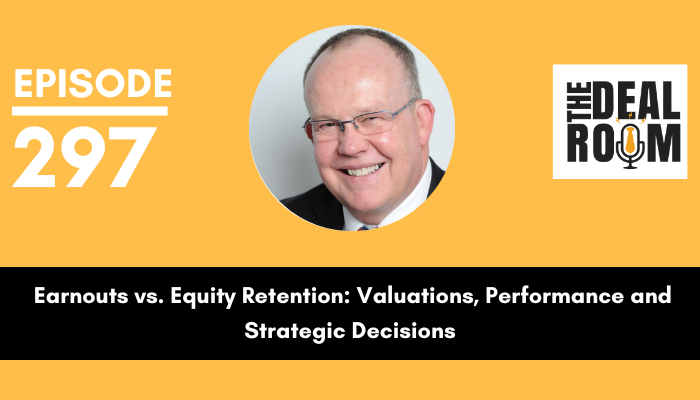
Earnouts & equity retention solutions can impact the relationship between buyers and sellers after a merger or acquisition. Knowing how is key to ensuring success.
This episode, Joanna Oakey and Rod Hore discuss performance trends in the services sector, particularly the staffing and recruitment sector, along with key insights some of the business owners in these sectors can use to prepare for succession or exit.
Key topics include:
- The gap between perceived and actual business value post-COVID
- Earnouts vs. equity retention: psychological impacts on sellers
- Why international buyers have disappeared from Australia
- How to build transferable value in personality-driven businesses
- Creating wealth during ownership vs. expecting a “pot of gold” exit
This is part 1 of this incredibly insightful two-part series, making it a must-listen insights for anyone involved in the services sector that is considering their equity value and strategy.
Tune in to The Deal Room Podcast now.
ABOUT ROD HORE
Rod founded HHMC Global to provide industry acumen and global knowledge to owners and managers of recruitment agencies. Rod’s innovative business strategies and well-grounded guidance result in clients realising their personal and corporate goals.
Following a career in the IT industry, Rod has spent 25 years working with executives in the staffing and recruitment industry. His advisory roles include board assignments, merger and acquisition mandates, corporate strategy and valuations. Leaders trust Rod when conscious decisions are required for their future.
From his base in Perth, Australia, Rod travels extensively for his work with recruitment organisations.
Connect with Rod
Connect on LinkedIn (https://www.linkedin.com/in/rodhore/ )
Find out more about HHMC (https://www.hhmc.com.au)
Get a copy of Rod’s book: Business Valuations in the Recruitment Industry https://info.hhmc.com.au/ebook-download-business-valuations
He always welcomes the opportunity to talk with Staffing and Recruitment Industry leaders on all topics related to the business of recruitment, including offshore outsourcing. They can get into my diary using this link: https://calendly.com/rod-hhmc/30min-zoom
00:01:09 Overview of current recruitment industry trends and post-COVID recovery.
00:05:08 Owners becoming more strategic; better leadership and future planning.
00:06:53 Succession strategies: third-party sales, employee ownership, shutting down.
00:09:41 Increasing trend of seller equity retention post-sale.
00:11:15 Challenges with earn-outs and how seller mindset can impact transitions.
00:15:01 Assessing if a business is saleable – the importance of external valuation.
00:17:33 Rod’s upcoming book on valuing recruitment businesses and “appropriately corporate.”
Introduction [00:00:00]:
Ladies and gentlemen, good evening. Are you ready? Okay, here we go. You’re listening to the Deal Room podcast. Join us as we bring you the inside scoop on business sales and acquisitions. Get across trends in the area and hear the industry’s best recount their real life tips, traps and experiences. Now, here’s your host, Joanna Oakey.
Joanna Oakey [00:00:24]:
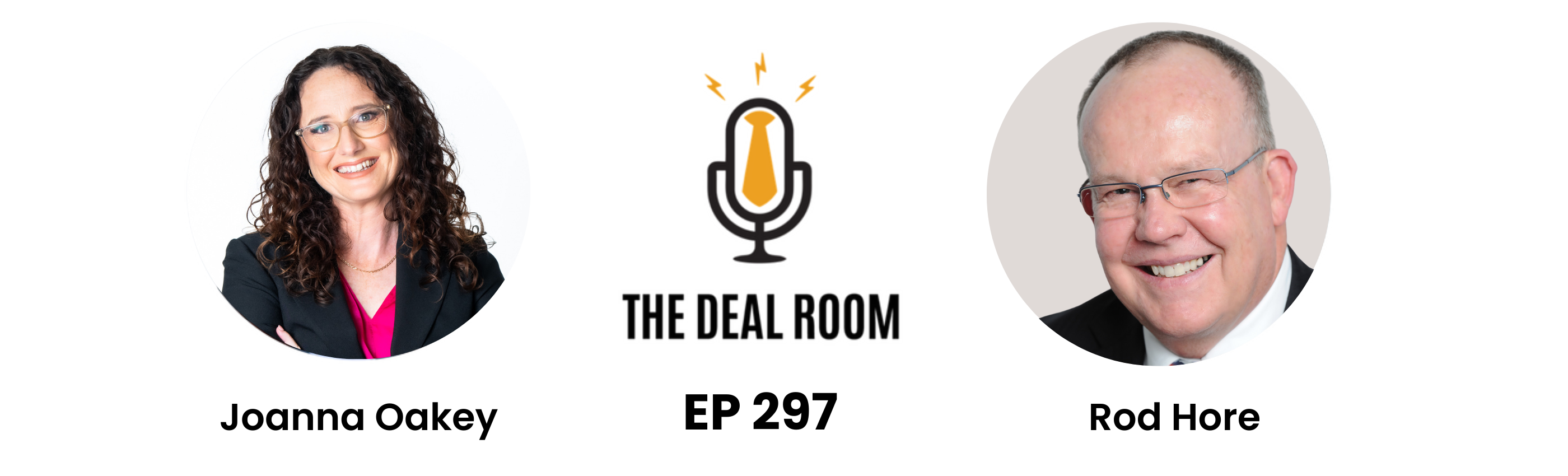
Hi, it’s Joanna Oakey here and welcome back to the Deal Room Podcast, a podcast proudly brought to you by our commercial legal practise, Aspect Legal. Now in this episode I’m talking with Rod Hore, Managing director of HHMC Global, all about the changing landscape of the recruitment industry and key strategies for business owners. With 25 years of experience working alongside executives in the staffing and recruitment sector, Rod’s strategic guidance helps clients achieve their corporate and personal goals. Now in this episode, Rod and I talk about the recruitment industry performance trends, Covid’s positive impact on recruitment, understanding wealth creation in small businesses. We talk about earnouts versus equity retention and we also look at market valuations. We also take a look at valuing and growing recruitment agencies and the complexity of in business sale agreements. This is a two part series. So today you have part one of Our two part series and make sure.
Joanna Oakey [00:01:34]:
You check your inbox. And if you haven’t yet subscribed, go ahead and subscribe for part two later this month. Rod, welcome once again to the Deal Room podcast.
Rod Hore [00:01:47]:
Thanks so much, Joanna. Very welcome to be back.
Joanna Oakey [00:01:50]:
It’s always so good to have you here, Rod. I love these discussions which I feel like we keep having on an annual basis and I think it’s a nice, it’s a fabulous rhythm. There’s so many things that I want to work through today. Some granular things like I want to talk about working capital because I feel like that’s a concept that many business owners who are gearing up for sale don’t quite understand and not don’t quite understand when it might be appropriate for them to be dealing with a working capital concept with a bite because not always relevant for all sales. I also just want to hear where the industry’s up to and then maybe we’ll have a general discussion about exit strategies for small business owners like so topical. What is it? How do they get out? How do business owners ultimately liquidate that asset if that’s what they’re doing? So that sort of succession concept. Where do we start? Why don’t we start with an update on the industry? So we’re talking to generally today about service businesses. However, you are particularly a specialist in recruitment Businesses.
Joanna Oakey [00:02:59]:
But you’re working together. Rod, how many years? I feel like it’s at least 15 years now.
Rod Hore [00:03:05]:
It is probably 15 years, yes.
Joanna Oakey [00:03:07]:
Yeah. Amazing, amazing. It’s just. And some fabulous businesses. We’ve both worked on that in that time. But what I’d like you to talk about just right now, perhaps, is just step back a bit. The recruitment industry as a whole and M and A in the recruitment industry. What are you seeing at the moment in the recruitment industry as a whole and M and A in the recruitment industry.
Rod Hore [00:03:29]:
Okay. So specifically in the recruitment industry, like a lot of industries, in 2020, you have to go back to Covid, because you can’t talk about anything without talking about COVID and the COVID year, whatever it is, that’s. And in 2020 there was obviously a decline because nobody knew what was happening and everybody just suffered in terms of revenue and how they were going to go about their business. But that followed with a massive couple of years, like an extraordinary couple of years for the recruitment industry. It was feeding from the buffet is the term that I used. They were just. There was opportunities and. And businesses were making a lot of permanent placements especially.
Rod Hore [00:04:07]:
And Tempa Contract followed a little bit on that as well. What’s happened is that it’s almost reverted to normal, but it’s come down off such a high in terms of the way that businesses are performing, that it looks like it’s a great decline, but it’s actually not. And today, or 2024, if you compare that to 2019, 2024 is actually operating at a higher level than 2019. It’s just that in the middle we had these extraordinary periods and that’s very hard for business owners to forget that period and actually just get back to doing the basics and doing the things they need to do. And all of this has impacted what’s going on with M and A. There’s actually another point as well. International buyers just about disappeared completely away from Australia. And I think the way that we treated some countries and the things that we did with our borders and that has had an impact and they found opportunities in other places.
Rod Hore [00:05:01]:
And the international buyers in general haven’t come back to Australia yet. There’s a few exceptions to that. And so the sorts of deals that are happening, first of all, the volume is much lower, but it’s amongst the privately owned Australian companies and tends to be at the smaller end. And so there’s a lot of activity and a lot of desire to do things, but the number of deals that are getting done is quite small. And I think a lot of that is that the buyers are still reminiscing about the profits they made a couple of years ago and the seller. Sorry, the sellers are reminiscing about the profits they made a couple of years ago. And the buyers, of course, are not going to pay for that. They’re going to pay for what they see as the economic conditions going forward.
Rod Hore [00:05:41]:
And so how those people align is actually a problem. And it’s also a situation where a lot of people left the recruitment industry back at the beginning years of COVID And so there’s a lot of new people in the recruitment industry now. And so it’s actually quite complex in terms of being a leader, because there’s a lot of training, there’s a lot of people who maybe don’t have a lot of experience and it’s back to doing basics, as I mentioned before, which means all the hard work, business development and so on, is required to. To get out there and make a damn.
Joanna Oakey [00:06:12]:
And what sort of discussions are you having with business owners at the moment who are thinking of the future, thinking of gearing up for succession for exit, building this business, what am I going to do with it? How do I best realise the value out of this asset I’m building? What does that discussion look like right now?
Rod Hore [00:06:31]:
Yeah, but first of all, this sounds terrible when I say it, but I think there’s a lot of good things came out of COVID in terms of how, in this case, the recruitment industry is performing. It’s like a whole range of business leaders got a big education in a hell of a hurry. And so there. This is a generalisation, but there are so many more people who are treating their business really strategically. They’re making decisions they wouldn’t have made before. They’re building leadership teams in a manner that they wouldn’t have built them before. And so there’s this explosion of good businesses in the industry, which I love. So the industry is very strong and what that reverts to is people who are very committed to building a good business, to building great leadership teams, to inspiring those leadership teams to take it further.
Rod Hore [00:07:15]:
And that’s impacting on, first of all, the wealth they’re creating, but secondly, what they might do in three years, five years and so on. And so there’s more realistic and exciting strategic plans in place for recruitment agencies than there has been before. It’s a very positive story. There is another side of it. Some people said, I can’t do this again and I’m out And so there are people who’ve left the industry or their business is now a shadow of what it was previously, but tend to concentrate on the good side.
Joanna Oakey [00:07:44]:
And the general discussion though often in looking at what that strategy is for succession in the future, how do I liquidate this asset in my business? Contend and depending on the size of the organisation obviously, but contend between we’ve got a third party buyer, we looking at employees to bring up to become owners. We’re looking at. Sometimes it’s about family succession as well. No, I don’t see that as much. And maybe it’s a reflection of the types of businesses that we deal with. Has there been a movement that you’ve seen?
Rod Hore [00:08:25]:
I think people are much more aware than they were previously. I don’t know. I don’t know if that’s true or not because there’s no way of measuring that. But I think people are quite realistic now. They’re still valuing their own personal business higher than it should be. That’s never going to change. But in terms of what the options are, I think people are more realistic. And there are certain types of business within recruitment and executive search is one of those which is very personality driven in terms of how the business operates, that most of those organisations know what their choices are, which is pass it on to the staff, in other words the next level to come through or basically shut the business down.
Rod Hore [00:09:02]:
There are not many choices because who’s going to buy a personality driven business and how do you pay for that and so on. And very small businesses I think are gradually understanding that they need to make wealth on the way through because they there is not a pot of gold for them. At the end of the day it’s a small business that can transition, they can pass on to somebody else but that’s not going to sustain them in the future in terms of the amount of money it’s worth, they have to have made their wealth on the way through. So all of those sorts of things seem to be much more realistic in terms of employees becoming part of the business that does seem to be increasing. Although it is still in my mind a it’s a really big multi year project to make that happen properly. And because there’s an education component and so on and there are lots of circumstances where it doesn’t really work, it’s still a high risk strategy. I think most people are looking to do some sort of an exit. There are quite a few in the recruitment industry, second generation businesses and now just recently there’s been one publicised which is a third generation business that is really rare.
Rod Hore [00:10:03]:
It’s. Yeah, mostly it’s people who come in, run the business for a good period of time but then pass it on to a completely new set of owners. Yeah, yeah.
Joanna Oakey [00:10:13]:
Actually one thing that I’m seeing a bit more of now than I had in the past is a slight uptick. Is sellers holding on to a bit of equity in the sale. It’s more. It more is buyer driven actually. Buyers requiring that sellers stay in with a bit of equity. There has always been a portion of the M and A market where that’s been part of the deal. But I just feel like that’s a little bit more happening a bit more at the moment, which I think is like an interesting comment on the market as a whole.
Rod Hore [00:10:46]:
But I think that’s part of the risk conversation, which is probably more in the open than it used to be because there are a lot of people who are saying I don’t want to manage this anymore, but I’m not necessarily going to retire. So what do you do with that person? If you can work out some sort of a business plan, maybe they’re running a remote office or something like that, that they can actually stay within the organisation but have a take the risk and the responsibility removed from them and they can get back to doing what they enjoy, which is running a small team and executing the activities. Then equity becomes part of the process. There’s more and more people also not doing the 100% transaction upfront, but maybe as an earn out progresses paying. That’s also related to share transfer as well. I think that that’s complication for not much benefit. But there’s all of those variations out there.
Joanna Oakey [00:11:34]:
Well, it’s an interesting discussion point because one of the sort of classic problems with using earnouts to keep a founder in the business for a particular period of time is we all know once someone’s run a business on their own a period of time, they, we call them almost unemployable and we know the reality. They get in if it’s part of this sort of earnout driving them. It’s almost like there with everyone but with many people who were owner founders, they get into this situation where they’re now having to report to someone. They’re being. They’re not choosing the path anymore. The buyer’s choosing the path and they’re just marching it. They, it becomes. They tick down the seconds until the earn out triggers and then they’re out the door.
Joanna Oakey [00:12:22]:
If they can even make it to the end. But I do sometimes wonder in these deals where we flip that and make it less earn out driven and more seller retains some equity in the business but he’s relieved of some of those bits that are causing them the pain that come from the ownership and management higher elements that it’s just like sometimes even just that change of their own thought process of being in the business from I’ve got to be here until this second to earn the end of the earn out versus I’m still, I’ve still got skin in the game. This is still my baby. But I’m relieved now some of the responsibility like I personally feel that can have a difference on the mindset and therefore the experience of both the buyer and seller in those situations. Do you have any thoughts on that?
Rod Hore [00:13:11]:
Yeah, look, I do. And on. It’s really complicated because you want to drive the project towards an outcome. Right. So in some ways you don’t want to get too philosophical on the way through and that’s why.
Joanna Oakey [00:13:22]:
Good points.
Rod Hore [00:13:22]:
Yeah, that’s. That’s why people take things that are proven or standard as much as there are any standards around. But in a perfect world you would have a great understanding of what the business requirements are and what the business requirements are for the transition. And that’s what an earn app’s all about, is to facilitate the transition. But you would also take into account the personalities and what’s driving the individuals and you would sort something out appropriate. So it may not be financially driven, it may be a transfer of relationships with clients and things like that. So whatever drives the people is what should be in the transition plan. But it doesn’t always get there and it’s complex and you’re quite often dealing with one side that might be very fixed in its views and another side that is approaching this for the first time and getting that all sorted out is.
Rod Hore [00:14:11]:
Takes too much time. It’s really complicated. And so that’s why I think people tend to say this is how a transition works rather than thinking it through or taking the time to explore and improve.
Joanna Oakey [00:14:23]:
Yeah, love it. Okay, all right, fantastic. So I just want to come back to a point that you made about making this decision about whether your business is going to have a value at exit or whether it’s a kind of business where really you need to be more focused on making wealth on the way through in order to extract your value rather than the pot of gold at the end. Can you give us some indicators and service businesses, particularly the recruitment industry, how does a business owner assess where they are in that sort of. In that spectrum.
Rod Hore [00:15:03]:
Yeah. Look, the brutal truth comes down by getting an external valuation of their business. Look, and we do a lot of.
Joanna Oakey [00:15:09]:
Those understanding, have you got a saleable asset right now?
Rod Hore [00:15:11]:
But also, this is not. This in on the accountants. But I’m not talking about an accounting type of valuation. I’m talking about this is how an external party will see your business. It’s a review and an assessment of your business as though you’re on the market. And that sort of market valuation, I think, is extremely valuable to people because it’s sometimes the first time that somebody’s put a mirror up to them and saying, this is how the world views your business, I find that valuable. And because it’s really hard to have a theoretical conversation about a business where, and I’ll use a few little trite lines if I can, the value of the business is the risk associated with earning the future profits. Now, you can say that quickly, but what does that really mean? And so you’re looking at revenue streams and you’re looking at the.
Rod Hore [00:15:58]:
How much of that revenue is forecastable or predictable and all of those sorts of things. And until you dive into that and do it in detail, the business owner tends to not understand the other side of that. Second point of that is that in terms of leadership structures, where do the business relationships sit, and so on. So the smaller the business, the more it sits with the owner. Very hard for the owner to understand that until somebody puts it down in black and white and describes why your business is not worth note. Or it could be on the positive side and say, hey, your business is going to be viewed really positively. So that happens as well. And it seems that most of my conversations now with when I’m first meeting people is in this area of saying this is where you sit in the character in terms of these characteristics of your business.
Rod Hore [00:16:42]:
And that means that you’ve got these choices and you’ve got these. This value, and you need to make some conscious decisions about what you’re going to do. Don’t drift towards an outcome. Make a conscious decision and understand where you’re sitting today and take advantage of this wonderful industry and wonderful position you’re in.
Joanna Oakey [00:17:00]:
Love it. Okay. And I guess also let’s talk about. I want to talk about the book that you. You’re about to write.
Rod Hore [00:17:11]:
Okay.
Joanna Oakey [00:17:12]:
Rods, we had this discussion beforehand. Rod’s not sure he’s up for actually writing another book yet, but. But tell us about the book that you’ve written, which we’ll make available to our readers and we’ll put a link through to that. What was that book about and what’s appropriately corporate? The book that you have in your mind that maybe one day you’re right.
Rod Hore [00:17:30]:
Maybe one day if I had as much energy as Joanna, they’ve written it already. The look, we do have a repeat of conversations which I still enjoy after 25 years, but. So the first book was about helping people to understand what the drivers are and what the components are of their business and where it sits compared to other businesses. And therefore these are the characteristics of the value of your business and what multiple of profit you might get and so on. If you went to markets, that was how to value a recruitment agency. The conversation gets a bit deeper though when you start talking about some of the things we just mentioned, which is where do you sit and what are your choices and how do you actually run your business? If you’re a five person business, as opposed to a 20 person business, as opposed to a 50 person business, what is appropriately corporate? Okay, how sophisticated do you need to be? Who should you pay attention to? From a technology point, from an accounting standards point, all of those sorts of things. And I think that’s the tough thing for somebody who’s running a business for the first time, is how do they get information and how do they assimilate it and how do they understand what’s appropriate for them, what’s suitable for them? And it’s because running a business, and I think you would agree with this, is a series of steps. And so you put something in place and you hope it lasts for a period of time because you’ve made an investment.
Rod Hore [00:18:46]:
But at some point you’re going to need to reinvest in that particular function. Accounting, onboarding, recruitment, whatever it might be, marketing. All of those components, let alone the core function of your business, need to be rebuilt at different times. And making the decisions about where to invest your time and money at what stage you’re at in your business to give you good return or to prevent you from running into compliance issues or whatever it may be. That’s a really complex decision for organisations. Appropriately corporate. A terrible name, but it’s the working title.
Joanna Oakey [00:19:20]:
I like it. It’s all in the tagline though, Rob. We need to think of a great tagline for it. No, but really important topics. I know you specialise in recruitment, but it’s the same question for any sort of business. That sort of question isn’t just about service businesses. No, it’s not sort of any.
Rod Hore [00:19:38]:
No. If you’re running a, I don’t know, a manufacturing business or something like that. When do you reinvest into your equipment? When do you do that? How do you decide on all those sorts of things? Or a trucking business or whatever it may be? Same decision points and it’s the same decision process and it’s almost the art of running the business is what decision do you make when.
Joanna Oakey [00:19:58]:
Well, that’s it for this episode of the Deal Room Podcast. We hope you’re now primed for your next deal with these pointers and have enjoyed these fascinating insights. Now, if you’d like more information about this topic, then head over to our website at the Dealroom Podcast, where you’ll be able to download a transcript of this episode as well as access any contact details and any other additional information we referred to in today’s podcast. Now, if you’d like to get in contact with our guests today and the services they offer, you can go ahead and check out our Show Notes for a link right through to them and their details. You can also book in directly with our Legal Eagles at Aspect Legal if you’d like to soundboard your next steps, discuss a legal question, or find out more how we can assist, whether that’s with buying or selling a business, or perhaps somewhere in between. Now, don’t forget to subscribe to the Deal Room Podcast on your favourite podcast player to get notifications whenever a new episode is out. We’d also love to hear your feedback, so please leave us a review and rating if you’re already one of our subscribers, or even if you’re listening to this podcast for the very first time. Every review helps our team produce valuable content for you.
Joanna Oakey [00:21:16]:
Well, thanks again for listening in. You’ve been listening to Joanna Oakey and the Deal Room Podcast, a podcast proudly brought to you by our commercial legal practise, Aspect Legal. See you next time, ladies and gentlemen.
Joanna Oakey [00:21:30]:
That will conclude this evening’s entertainment. Thanks for listening to the Deal Room Podcast. To find out more about this episode and other episodes in the series, check out the Show Notes or head over to our website at thedealroompodcast.com au.
Disclaimer:The material contained on this website is provided for general information purposes only and does not constitute legal advice. You should not depend upon any information appearing on this website without seeking legal advice. We do not guarantee that the contents of this website will be accurate, complete or up-to-date. Liability limited by a scheme approved under Professional Standards Legislation