Podcast: Download (Duration: 29:05 — 23.3MB)
Get notified of new episodes: RSS
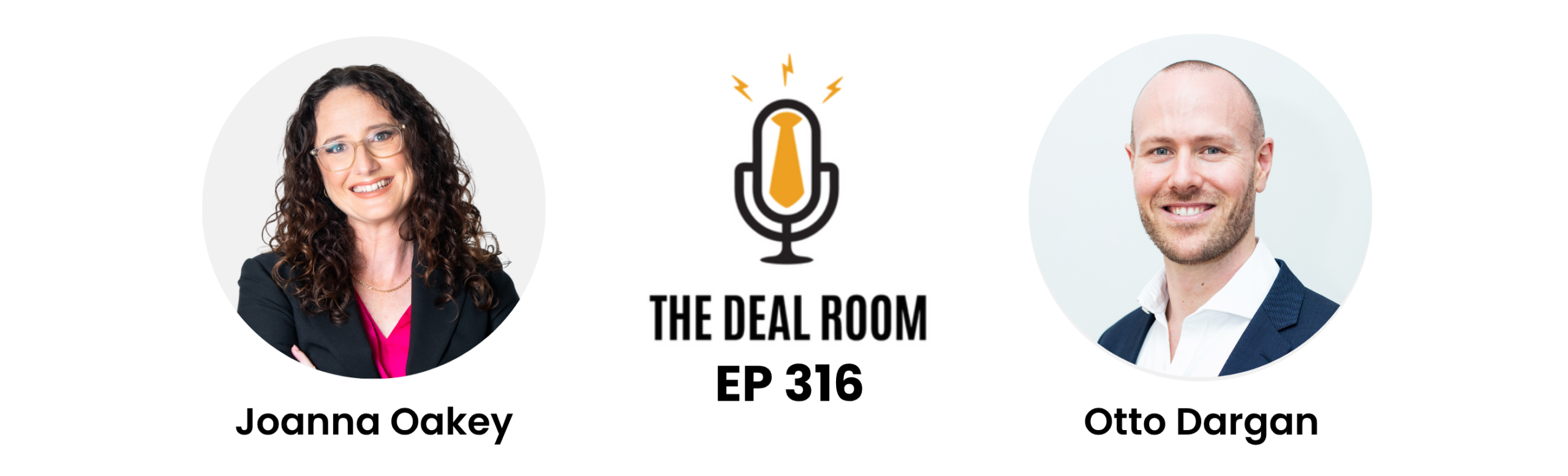
This episode of The Deal Room Podcast looks at the practical side of buying a business: financing. Otto Dargan, founder of Home Loan Experts, joins Joanna Oakey to explain what banks check before approving a loan to buy a business, how to minimise the personal security you put up, and where AI already helps with due diligence.
In this episode of The Deal Room Podcast (Part 2 of 2), Joanna Oakey is joined again by Otto Dargan, founder and CEO of Home Loan Experts, this time for the practical side of buying a business: financing.
Otto has spent 24 years in mortgage broking, including 2 wins of Australia’s Brightest Broker and the 2019 Australian Brokerage of the Year award.
In this episode, they unpack:
- Why a business loan works nothing like a home loan
- What banks actually check before they’ll approve a loan to buy a business
- How to minimise the personal security a bank asks for
- Why who you work with at the bank matters so much more for a business loan than a home loan
- What’s slowing loan approvals right now, and how buyers can get ahead of it
- Why the loan term, and annual reviews, can matter as much as the interest rate
- How to present your plan the way the bank’s credit assessor wants to see it
- Where AI already helps with due diligence and cash flow projections, and where a “vibe cashflow” goes wrong
Otto and Joanna also get into the surprises first-time business borrowers run into, from shorter loan terms and higher interest rates to extra paperwork, and why the loan term can matter more than chasing the lowest interest rate.
This one is essential listening if you’re preparing to buy a business, or already mid-acquisition and want to know what your bank is actually assessing behind the scenes.
Catch Part 1 first if you haven’t, where Otto and Joanna cover AI’s growing effect on how businesses get valued.
ABOUT OTTO DARGAN
Otto Dargan is the founder and CEO of Home Loan Experts, one of Australia’s leading specialist mortgage brokerages. He began his career as a mortgage broker at 18 and founded the business in 2006, building it into a team of around 328 people across Sydney and Kathmandu, including Alaya, the group’s Nepal-based outsourcing operation. Home Loan Experts is known for solving complex loan scenarios that other brokers and banks turn away, and has settled more than $8 billion in home loans.
A 2-time winner of St George and The Adviser’s Australia’s Brightest Broker competition, Otto has spent 2 decades working across every part of the business, from credit and compliance to marketing and operations. He is now focused on transforming the company into an AI-native organisation, using AI agents and internal training programs to reshape how mortgage broking and outsourcing work is done.
Connect with Otto Dargan:
- LinkedIn: linkedin.com/in/otto-dargan-2ab9a74
- For home loans, financing to buy a business, investment loans, or just to talk AI: homeloanexperts.com.au
Episode Highlights
0:00 – Introduction
1:12 – Otto’s 24 years in mortgage broking
2:50 – How a business loan differs from a home loan
4:48 – What banks check before funding an acquisition
6:40 – How to minimise the personal security you put up
8:51 – Where buyers most often go wrong
10:14 – Why approvals are slowing and how to get ahead
11:59 – Looking beyond the interest rate
14:05 – How much can you borrow against a business?
15:43 – Common surprises in business finance
16:59 – The bank as your partner in risk management
18:07 – Presenting your application the way the bank wants it
19:57 – Where AI fits in financing and due diligence
22:42 – Why you should never do a “vibe cash flow”
25:15 – Otto’s final advice on business finance
26:09 – How to contact Home Loan Experts
27:15 – Otto’s most unusual loan
27:58 – Outro
FREQUENTLY ASKED QUESTIONS (FAQs)
Q1: What’s the difference between a business loan and a home loan?
Otto Dargan says a home loan is like buying a standard car, the terms are fairly uniform. A business loan is more like a custom build, what lenders say they do and what they’ll actually do for you can be quite different, and security options like inventory, rent rolls or invoices can substitute for a house.
Q2: What do banks check before approving a loan to buy a business?
Otto Dargan says banks look at the business’s past financials, its assets, and whether the buyer has the experience to run it. They also want a cash flow projection for the future, and treat it more cautiously than an optimistic investment banker might. Risk to the bank, not how much you might make, is the real focus.
Q3: How can buyers minimise the personal security a bank asks for?
Otto Dargan says the easiest way is to put a lot of cash into the deal. Otherwise banks default to wanting your home and investment properties as security, and a director’s guarantee means they can sell almost anything if things go wrong, so you may have to argue for something else. His view is that the bank should have sufficient security without getting greedy and taking everything. He adds that offering your home as security can mean a longer loan term, better cash flow and a better interest rate, and that different lenders accept different business assets, such as inventory, so choosing the right lender matters.
Q4: Why does who you work with at the bank matter so much?
Otto Dargan says the individual banker matters far more for a business loan than a home loan, and that this holds across all the banks. Some have the authority to approve large loans themselves and are quick and experienced, while others can take months and don’t really know what they’re doing. A broker like his team deals with different business bankers and follows up with them to hold them accountable.
Q5: What’s slowing down business loan approvals right now?
Otto Dargan says approval speed varies by lender, and right now a common cause is a lender running a pricing special, which floods them with applications and slows everything down. His advice: have everything ready before you need it, get the bank to assess you upfront, and give lenders complete, well-organised information in one go.
Q6: How much can you typically borrow against a business?
Otto Dargan says there’s no fixed rule. A well-run franchise might secure 60-70% of its value because lenders know the model. For a smaller business where the buyer knows what they’re doing, some lenders will do an unsecured loan of around $200,000, as a rough guide. Larger loans usually mean lenders ask for more security and try to bring the loan amount down.
Q7: Where does AI actually help with a business loan application, and where does it go wrong?
Otto Dargan says AI is genuinely useful for organising due diligence documents and drafting a first cash flow projection, but it has to be checked, not trusted blindly, what he calls a “vibe cashflow.” For a business plan, he suggests using it to ask discovery questions rather than write the plan for you.
Q8: What should buyers think about besides the interest rate when getting a business loan?
Otto Dargan says the loan term is probably the most important thing for a business loan. A five-year term on a large loan can leave you with no cash flow from the business because it all goes to repayments. He also flags annual reviews, where the lender looks at updated financials and may ask for more cash if they’re unhappy with how the business is going, and says to put your risk hat on and be a bit pessimistic up front.
Q9: How should you present your business plan and numbers to a bank?
Otto Dargan says to make it easy for the bank. A business plan of 80 to 200 pages is wonderful for your business, but a credit assessor who probably doesn’t know the industry won’t work through it. Present it the way the lender wants, including copying your cash flow projection into the lender’s own template, and give them everything organised in one go.
Note: this transcript was generated automatically, so it will contain errors. It’s here as an easy way to scan for anything relevant to you, not as a word-perfect record of the episode.
(0:00) Announcer: Ladies and gentlemen, Good evening. Are you ready? Okay, here we go. You’re listening to The Deal Room Podcast. Join us as we bring you the inside scoop on business sales and acquisitions. Get across trends in the area and hear the industry’s best
(0:24) Joanna Oakey: Hi, it’s Joanna Oakey, and welcome back to The Deal Room Podcast, a podcast proudly brought to you by our commercial legal practice, Aspect Legal. In this episode, we cover part two with Otto Dargan, founder and CEO of Home Loan Experts, who spent 24 years in mortgage broking. This time, we’re talking about financing a business purchase, and we cover how a business loan differs from a home loan, what banks actually check before they fund a deal, how to keep the personal security you put up to a minimum, and where AI helps with the paperwork, and why you should never do a Vibe cash flow. So let’s dive in. Otto, huge thank you once again for joining me on the Deal Room Podcast.
(1:10) Otto Dargan: Yeah, great to be here.
(1:12) Joanna Oakey: Fantastic. Now, last episode where we were talking together, we were talking about everything AI, which is obviously a topic you and I both love. But today we’re talking about financing which is very practical and useful for our audience. Our audience full of buyers and advisors dealing with buyers who of course quite often need financing for the acquisition of their shares or the business that they’re purchasing and of course then potentially for the businesses they’re running it. So maybe give me a bit of an overview, Otto, of where your journey has been in that financing area, because I feel like it’s been a long journey and an interesting journey. And who do you work with and what are the insights that you have in this area?
(2:02) Otto Dargan: Okay. So a little bit about, um, my background. So, uh, I started as a mortgage broker when I was 18, back when it was like the wild West days when anyone could become a mortgage broker. Um, uh, and so that’s a long time ago now, that’s like 24 years that I’ve been in mortgage broking. So I’ve seen the whole industry go through many stages and different things like that. Um, I’ve won Australia’s Brightest Broker twice, and we were named Australian Brokerage of the Year in 2019, which was pretty cool. So we know our stuff. And, yeah, we’ve helped people do all sorts of weird and wonderful things. You think you’ve seen it all, and then next week comes. Yeah.
(2:50) Joanna Oakey: So what are some of the, I guess, standout things that you think it’s useful for our listeners to be aware of if they’re getting funding for an acquisition? Let’s start there.
(3:01) Otto Dargan: Yeah. I think probably the first thing to know, because a lot of people have got a home loan before, but maybe they haven’t got a business loan or business finance before. And it’s quite different. Kind of think of it as like when you’re getting a home loan, it’s like you’re getting a standard car, right? Everything’s kind of standard. Whereas when you’re getting a business loan, it’s more like you’re getting a custom build, right? And so there’s the lending policies, what they say they do. And then what they actually do can be quite flexible and quite different.
(3:36) Joanna Oakey: So talk us through that. Sorry, I don’t want to interrupt you, but I do want to dig in more either now or soon into what that difference is between what they say they do versus what they will do.
(3:49) Otto Dargan: So think of it for a home loan, you can use your house as security, but for a business loan, they can be really flexible. In some cases, they can use like a rent roll. if you’re buying a you know property management business, um they can use inventory as security they can use commercial property um there can be all sorts of things um in some cases invoices that you’ve issued that you’re going to get paid on and so it’s really quite flexible, um for franchises um if it’s if it’s a really good business then they’ll lend against the value of the franchise there’s all sorts of stuff um, and so it’s really hard to give people a set of this is how it works so the key thing is, there there are hard and fast rules but they’re complicated they’re different for different industries and so it’s just something you need to either talk to your bank so you understand what they do or speak to an expert like us.
(4:48) Joanna Oakey: Brilliant. Okay. So, what is the best way for buyers to prepare for financing?
(4:57) Otto Dargan: Yeah. So, typically, a few big things that a bank will want to see when you’re buying a business is effectively they want to do due diligence on the business too, right?
(5:12) Otto Dargan: The bank doesn’t care if you make $10 million. That’s wonderful. But you make that money, not the bank, right? So what the bank cares about is the risk to the bank. And I think that’s actually a good thing because if there’s risk to the bank, there’s probably risk to you. And avoiding failure is always nice. So the bank will effectively ask questions and go in and try and understand the business as well. So they’ll want to see past financials for the business. They’ll want to know about the assets that the business has. Um one thing they really look at is are you experienced to run this business, um something that i’m always a little bit concerned about is when someone’s kind of, you know playing outside the area of expertise um leadership is highly transferable but but do you do you know that industry do you know how it works um because if not then that can be quite risky, so they want to know you’ve got the experience, and they really want to know um the future cash flow of that business so they’ll they’ll typically do a cash flow projection and maybe an investment banker might make a very, um a very optimistic cash flow projection a bank may think differently, and may think will you actually do it right, um and so then it’ll depend on the type of business as to what else they look at.
(6:40) Joanna Oakey: Brilliant. Okay, wonderful. We have lots of buyers who come in wanting, I guess fairly obviously, to reduce or minimise the amount of security themselves they have to put up from a personal perspective. So, what are you seeing in the market at the moment?
(6:59) Otto Dargan: Yeah.
(7:00) Joanna Oakey: And what makes it easier, easiest to minimise the amount of security?
(7:05) Otto Dargan: Well, the easiest way to have minimal security is to put in a lot of cash into the deal.
(7:13) Joanna Oakey: So, they don’t want to do that either. They don’t want to do that either.
(7:16) Otto Dargan: So, if you’ve got a huge amount of money, then no problem at all. But banks love to have as much security as possible. Typically, what they want to do, they want to take your home as security too and all your investment properties too. That’s kind of their default position. And you kind of have to argue with them if you want something else. Um the reality is right they’re they’re they’re going to try and take a guarantee over everything, um but if they’ve got a director’s guarantee from you and things go wrong they can they can pretty much sell anything they want right and so personally i think um what it’s about, is making sure the bank has sufficient security they’re not getting greedy and just taking everything, right?
(8:03) Otto Dargan: And that it makes sense for what you’re looking to do, looking at the overall picture. Maybe if you’ve got your home as security, then they can have a longer loan term and that improves your cash flow, right? And you get a better interest rate. Maybe you don’t want to do that, but it means the loan will be a bit more difficult for you because the term will be shorter. So it’s about thinking about the overall position. And understanding which lenders can take which parts of the business assets as security. So maybe one of them will be happy to look at taking the inventory and maybe another one won’t. So it’s a bit about choosing the right lender and it’s a bit about understanding your overall needs.
(8:51) Joanna Oakey: And what do you find buyers most often um you know go wrong in terms of their understanding of how the finance will work you know where where where do you see these um uh misunderstanding sorry cut for a second what’s the word that i’m saying misunderstanding uh i can’t even speak
(9:14) Otto Dargan: Where things go wrong i think.
(9:15) Joanna Oakey: Just keep it okay that’ll do all right where do you see that things most often go wrong with buyers?
(9:21) Otto Dargan: Yeah, I’d say the number one thing is who you work with at a bank really matters. And so, for us as mortgage brokers, we deal with different business bankers or commercial lenders. And if someone goes to a bank direct, they’re doing a similar thing. But the thing is um who you actually work with matters so much for a business loan, so much more than it does for a home loan because some of them they have their own authority and can approve large loans themselves and it’s all very easy and simple and they’re really experienced, and some of them can take months to get back to you don’t really know what they’re doing, and this is universal across all the banks and so who you are working with is everything.
(10:14) Joanna Oakey: Interesting. Okay. So, I mean, you mentioned speed. Speed is a very important component in an acquisition in everywhere, including financing. And we’re seeing at the moment in the market timeframes push out because of a slower speed of approvals of getting the financing in. What’s the reason for that auto and what do buyers do to get ahead of that?
(10:44) Otto Dargan: I think it really, it varies so much by lender that at any one time you’ll sometimes have one lender just be really busy and another lender not be. And there’s so many reasons for this. But right now, like the most common reason is say a lender has a pricing special. Typically, everyone wants to go and apply with them and then they get really busy and then they get really slow. And um so that can be frustrating so just the key thing is um, in my opinion is always have everything ready um where possible have the bank assess it up front so then when you find a business you’re you’re already like in a really good position to act quickly, and when you need to provide additional information make it really easy for the bank like have give them everything in one go uh, really well organized basically so they can’t screw it up, um and then what we do we we follow up with them um and we want to make sure that they tell us exactly where the loan is at what the next stage is what the problems are we ask a lot of questions so we hold them accountable effectively.
(11:59) Joanna Oakey: And we – sorry, I’m just trying to work out which one is a better question here. Okay, let’s talk about interest rates. Of course, that’s one of the key measures for everyone in what makes a loan look good. So what else, I guess, though, should our buyers or anyone who’s after funding from a business perspective be thinking about outside of just the interest rate?
(12:27) Otto Dargan: Yeah. For me personally, I always like to, I think loan term is probably the most important for a business loan, because often the loan term, if there’s like a part of it that’s unsecured or there’s not so much security, the bank may want say a five-year loan term. And if you’ve got a large loan and you want to pay it, if you’ve got to pay it off in five years, like you’re not going to get any cashflow from that business. It’ll probably all be going to the loan. And I’m sure the bank is happy, but maybe you aren’t. So negotiating on the loan term is, I think, really important. And the security that you have and the risk position of the business has a big impact on what you can negotiate in that area.
(13:14) Otto Dargan: Um, other things are annual reviews, um, where lenders are doing an annual review and you’re giving updated, um, financial statements and things like that, then that’s a potential risk point in the future where maybe they say, actually, we’re not that happy with how the business is going. And, um, then they start talking to you about, are you going to add more cash? What are you going to do? Um, and so, um, I think it’s really important like when acquiring a business, And it’s not just about the loan for acquiring a business, but the number one thing is risk. And we all get kind of dollar goggles and excited. But you want to also put that risk hat on and be a bit pessimistic. And that little bit of thinking that way up front can save a lot of problems later.
(14:05) Joanna Oakey: Absolutely. Actually, that’s our motto all the time. Preparation, preparation, preparation. Know what you’re getting into and then preparation. Okay, all right. So what about some general, you know, concepts that might be useful for our buyers, what they can or can’t borrow against, or what the likely amount is that they’ll be able to borrow secured just on the business itself, like in terms of the percentages. Are there some general percentages across the markets?
(14:39) Otto Dargan: Yeah, it varies so massively. So like say you’re buying a franchise, you might be able to borrow, you know, 60, 70% of the business value because it’s, the lenders know that that particular franchise, it’s well run. It tends to generally be successful, generally be low risk. And so then they’re very comfortable lending on the franchise value. Um whereas um for say a smaller business and you tend to know what you’re doing they may be comfortable just giving you an unsecured loan so some lenders can do like 200,000 and again these are, rough guidelines right that’s pretty much unsecured um and then for larger businesses um that’s where then they they really want to talk more about security and they want to bring the loan down as much as possible. So I wish I could say there’s some general rules, but there really aren’t. Yeah. All right. Okay.
(15:43) Joanna Oakey: All right. If there’s no general rules, are there some general myths? What are some common myths that you might have people coming in with business owners thinking about funding that are just wrong?
(15:58) Otto Dargan: Yeah, I think it’s more a lot of surprises because business banking is so different, be it that like the loan term might be shorter or that the interest rate will be higher or that the bank wants to take everything as security or that the bank’s so slow. And so these are the things that kind of come as a surprise the first time someone does something like this and also the additional documentation. So like um you know a business plan cash flow projection maybe your resume maybe family tree of the different companies involved and things like that, so um it just gets a bit more complicated but to be honest it’s not it’s not that difficult, it’s really just about articulating it well and being organized and and i think if you’re if you’re buying a business like you want to be able to articulate what your plan is and where your cash flow is going otherwise like probably don’t buy it.
(16:59) Joanna Oakey: Yeah. It’s interesting. Many buyers don’t want to do the amount of due diligence that quite often we think they should be doing. But I think the good thing is sometimes in a funding situation, they have to. So actually, I think sometimes they’re really good questions that they’re forced to ask that they may not want to delve into in so much detail. Given many of our buyers are entrepreneurs and we know all entrepreneurs are terribly impulsive, Otto, but…
(17:34) Otto Dargan: Not me. Yeah, no, the bank is your partner in risk management. That’s assuming a couple of things, that they’re asking great questions, right? That they know what they’re doing and they’re trying to manage the risk properly. Then they’re helping you, no? Um, it’s, it’s when they don’t know what they’re doing and they’re just kind of asking for random things and it’s just over-complicating the process. Um, we, we like to just argue with them in those cases and say, you don’t need these things. Yeah.
(18:07) Joanna Oakey: I think that’s a really fair comment actually, because I think you’re right. There can be a level of questions that are very useful and good questions that, you know, buyers should have actually already thought about if they haven’t, you know, already, but you’re right. There’s some that are just a little bit silly. Actually, this is a particular thing at the moment I feel in the market that we’re seeing banks take longer, funders take longer to approve funding, but then the forwards and backwards at the moment, it can be a bit painful and I think a lot of that at the moment is verging on the ladder that you’re talking about, Otto. So, I guess you’re talking about his benefit of having someone stand in the middle of these conversations rather than you having to deal with all of these questions yourself.
(18:57) Otto Dargan: Yeah, and articulating what you’re saying in a way that makes sense to the bank. You know, maybe people create a business plan, but it’s like 80 to 200 pages long. And that’s wonderful for your business, but the credit assessors then are going to have to read through it. They probably don’t understand the industry, you know, and so then that’s just not going to work for a bank. And it would depend on the deal size as well, but presenting it the right way for the lender really matters. And it varies between each lender. So, like, you may create a cash flow projection, but then the lender has their own template. And so we’ll make sure that that’s copied across and that it’s exactly the format the bank wants. Just the key thing here is give it to them the way that they want it. Like that’s the way the credit assessor is used to. That’s what they like that’s what they can enter in their system so just don’t make it hard for the bank.
(19:57) Joanna Oakey: Yeah i think that’s a really good point um now one of my sort of last questions here is about ai we started in our last episode with the whole ai topic um and we’re riffing a lot on AI generally in businesses, but bringing it back specifically to financing and acquisition or financing businesses, where does AI have a role? How are you guys seeing, you know, where AI is right now, but also what are you looking, what are you seeing in the future?
(20:36) Otto Dargan: Yeah. So maybe I’ll just mention in terms of like getting a business loan, how it can be really useful. Because I think that’s something that will help a lot of your listeners, AI is really good at organizing documents which that helps a lot for due diligence it helps a lot for getting a loan and so it can make sure you provide all the documents they’re well labeled, they’re in folders which makes it easy, Um, it can help with things like the cashflow projection. Um, it’s pretty, it’s a bit of an Excel wizard. However, you’ve got to check it. It’s got to be your own thinking. Like you shouldn’t just be doing a vibe cashflow. That’s bad.
(21:18) Joanna Oakey: Vibe cashflow. I’m like, I don’t know if I’ve heard of that.
(21:21) Otto Dargan: Yeah. We’re not the U S treasury. We we’d like to do things properly around here. Okay. So, um, then for your business plan, you can get it to ask you discovery questions. To articulate what your plan actually is. Just don’t get it to create a school report. We want it to be actually your business plan, not this wonderful long document, that’s filled with all these things that are not actually from you. So, it can be a really helpful partner in articulation, clarity, organization. What it shouldn’t be is thinking for you. You are the one buying the business. You can use it to brainstorm ideas, strategies, and things like that. But ultimately, you’ve got to kind of play the red team and say, no, that’s nonsense. That’s really good and things like that. So that’s what I see as AI’s role. And I think in due diligence, it can be quite handy because it can see patterns in things that you may not be able to see or cross-reference different documents and things like that. But I think buying a business is like taking your grandma to the doctor. There’s always going to be something wrong, right? You’ve got to kind of accept that as well and just think, how big is this risk?
(22:42) Joanna Oakey: I love that. Well, there’s two fabulous quotes there, Otto. Buying a business is like taking your grandmother to the doctor. That’s always going to be something. I don’t know. Sad, sad call. Like, we apologize to all the grandmas out there. Otto, really? That was you, not me. But don’t be doing vibe cash flow forecasting. I like it.
(23:06) Otto Dargan: Yeah. And I’m guessing, Jo, you probably don’t want people doing vibe legal contracts.
(23:11) Joanna Oakey: Yeah, yeah, yeah, yeah, yeah. I’ll tell you what. But, I mean, it is the funny, I mean, you know, you and I are both like absolute advocates for using AI in so many areas. But I think the funny thing is when you’re in a profession, and I see this all the time in so many different ways, you know, AI makes it very easy for people who don’t know anything about a topic to get in and feel like they’re a master of that topic when actually they’re creating absolute goddamn chaos. And I’m sure they do it in the finance area. 100% they do it in the legal area. But I think where AI really helps is when you understand an area enough to be able to be that filter for the AI and you’re able to work out, you know, what’s nonsense and what’s really useful stuff. And I think that maybe that’s the line right now that’s very grey. So that’s where the opportunity is for growth, I think.
(24:15) Otto Dargan: Yeah, and that’s why experts still have a job because the experts can look at what AI does and say, well, that’s nonsense and actually you should be thinking about it this way and actually this doesn’t even matter, right? Yeah. And it’s so hard when you’re not an expert, Because you look at AI, it looks like it’s done a fantastic job. We can spot a vibe cash flow pretty quickly, right? But the easiest thing is just ask the buyer a few questions about where the business is going and what plans they have after, the transaction goes through. And you can then very quickly tell whether they’re just making a bunch of assumptions or whether they’ve worked with their accountant and really thought about it or whether it’s, something created at 3am by an AI agent, maybe on their phone.
(25:15) Joanna Oakey: Maybe on their phone. I like that last bit there, Otto. Love it. Otto, that has just been absolutely fascinating. Thank you for talking us through the world of financing and business acquisitions and business as a whole, I guess. Is there anything I didn’t ask you that I should have asked you, Otto? Otto.
(25:32) Otto Dargan: No, I don’t think so. I think just the key thing is that business finance, it’s complicated. It’s bespoke. There’s a lot of things that can be done that people think can’t be done. And there’s a lot of things that common sense would say you can do which can’t be done. And so it’s a very strange area. That’s what I love about my industry is just, nothing makes a lot of sense unless you’re actually in it. So it keeps things entertaining.
(26:03) Joanna Oakey: Well, people would say that about law as well, I think, as well. So there you go.
(26:06) Otto Dargan: I would definitely say that about law.
(26:09) Joanna Oakey: Otto, can I just say a huge thank you for coming on to the show? And before you go, though, if anyone’s listening here and they’re thinking, oh, my goodness, I’m thinking about buying a business, but this is a bit of a confusing mess, this whole financing stuff, how can they find you and your team?
(26:26) Otto Dargan: Yeah, so we’re homeloanexperts.com.au. And yes, we do home loans, but we do business lending and commercial lending as well. Really, we’re a specialist mortgage broker. So we do a lot of things that are outside of the box or complicated or high net worth or expats. And so we’re really experienced at doing the difficult stuff. And honestly, it’s more fun, right? So we’ve done a lot of very unusual loans, a lot of big loans, small. We’ve really just had a huge cross section and we’ve got quite powerful AI internally that we use to help people, where there’s these more complex transactions and we need to articulate what they’re doing to a business lender.
(27:15) Joanna Oakey: Love it. And, well, you gave me the thread of one more question I really have to ask before it closes. Most unusual loan.
(27:25) Otto Dargan: Oh, my God. We’ve done an underground house in Coober Pedy. We’ve done a house in the Northern Territory that is cut off by the floods for three months every year. The value I had to take a helicopter out.
(27:41) Joanna Oakey: Wow.
(27:42) Otto Dargan: We’ve done loans for every profession. I maybe won’t name them all.
(27:49) Joanna Oakey: I like that, every profession. Love it, Otto. Thank you so much for coming on to the Deal Room Podcast.
(27:56) Otto Dargan: Great. Great to chat, Jo.
(27:58) Joanna Oakey: Well, that’s it for this episode of the Deal Room Podcast. If you enjoyed this one, make sure you subscribe so you never miss an episode. If you missed part one with Otto, where we get into how AI is repricing businesses, go back and have a listen. To talk financing with Otto and his team, head to homeloanexperts.com.au. The link’s in the show notes. And to book a call with our legal eagles at Aspect Legal, head to aspectlegal.com.au. That link’s in the show notes too. Thanks again for listening.
(28:30) Announcer: You’ve been listening to Joanna Oakey and the Deal Room Podcast, proudly brought to you by our commercial legal practice, Aspect Legal. See you next time. See you next time.
Disclaimer: The material contained on this website is provided for general information purposes only and does not constitute legal advice. You should not depend upon any information appearing on this website without seeking legal advice. We do not guarantee that the contents of this website will be accurate, complete or up-to-date. Liability limited by a scheme approved under Professional Standards Legislation