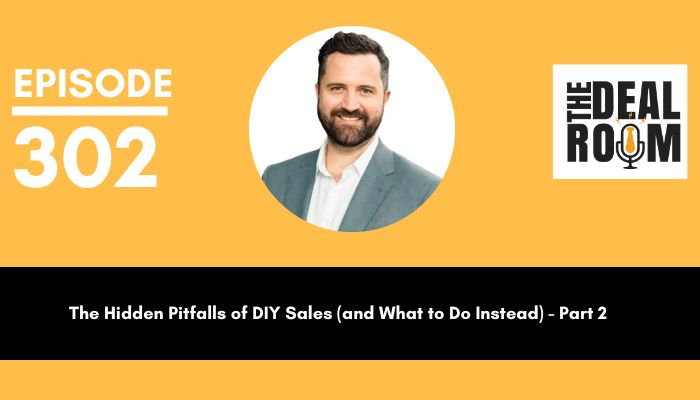
Selling a business isn’t just about finding a buyer—it’s about getting the deal done right.
In Part 2 of this two-part series, The Deal Room Podcast welcomes back Matthew Newton from Bonza Business & Franchise Sales to unpack what really drives deals across the finish line.
In this episode, we break down:
- A unique framework that can increase deal completion and reduce risk
- Buyer behaviours that signal red flags—and how to spot them early
- Why “walk in, walk out” deals can cause confusion and kill trust
- Smart strategies for cost control during the sales process
- What most DIY sellers get wrong—and how brokers bridge the gap
This episode is full of practical advice for sellers, brokers, and advisors supporting business transitions.
🔥 Tune in for a real-world conversation on how to avoid deal failure and drive better exits for small business owners.
Tune in to The Deal Room Podcast now.
ABOUT MATTHEW NEWTON
Matthew Newton is the General Manager at Bonza Business and Franchise Sales, with over 15 years of experience leading high-performing sales teams across various industries. He is deeply passionate about helping SME owners navigate the complex process of selling a business, especially family-owned ventures. With a strong focus on trust, storytelling, and real-world impact, Matthew champions innovative solutions that put people first. His work is driven by integrity and a desire to redefine how business transitions are handled in Australia.
Connect with Matthew:
- LinkedIn: Matthew Newton on LinkedIn
- Email: [email protected]
ABOUT BONZA BUSINESS AND FRANCHISE SALES
Bonza Business and Franchise Sales is a national brokerage that delivers innovative, team-based solutions to support buyers and sellers across all stages of the business sales journey.
Resources:
- Bonza Business and Franchise Sales – Learn more about Bonza’s team-based brokerage model. https://www.bonzabfs.com.au
The Road to Settlement Framework – Bonza’s structured approach to successful business sales, ensuring smoother transitions and higher deal completion rates.

Timestamps
03:00 – Building Trust to Reduce Buyer Risk
06:50 – Road to Settlement in a $3M Deal
08:30 – Managing Sale Costs and Avoiding False Starts
12:15 – Marketing Reach and Buyer Behaviour Post-COVID
16:00 – The Problem with “Walk In, Walk Out”
18:45 – Educating First-Time Sellers
20:10 – The True Cost of DIY Sales
23:45 – Filtering Real Buyers from Noise
Introduction:
[0:00] Ladies and gentlemen, good evening. Are you ready? Okay, here we go. You’re listening to The Deal Room Podcast. Join us as we bring you the inside scoop on business sales and acquisitions. Get across trends in the area and hear the industry’s best recount their real-life tips, traps, and experiences. Now, here’s your host, Joanna Oki.
Joanna Oakey:
[0:25] Hi, it’s Joanna Oki here and welcome back to The Deal Room Podcast, a podcast podcast proudly brought to you by our commercial legal practice, Aspect Legal. Now, in this episode, which is actually part two of the two-part series, I continue my conversation with Matthew Newton from Bonza Business and Franchise Sales, where we dive deeper into the processes and philosophies behind the standout success in small business transactions that Bonza is having right now, particularly with Bonza’s collaborative framework called Road to Settlement, which I absolutely love.
Joanna Oakey:
[1:04] Matthew leads a national team at Bonza that’s innovated the sale process for SMEs, breaking down some of the traditional inefficiencies and bringing together brokers, sellers, buyers, and advisors to walk the same path side by side all the way to settlement. And in this episode, Maddie and I talk about the road to settlement model and how it boosts deal completion rates. We’re also talking about bonds as marketing strategy and buyer engagement techniques. And finally, we touch on the unseen risks of DIY sales and the value of professional guidance. I tell you what, there are some interesting stories there, let me tell you. So whether you’re selling, advising, or just planning ahead,
Joanna Oakey:
[1:52] this episode today is packed with insights that could save you time, money, and stress. So let’s dive back in for part two with Maddie Newton.
Matthew Newton:
[2:03] Let me ask you a question. Who’s going to know more about the business? Me, who’s been looking after on the market for a couple of months, or the person who’s been running it for 25 years? Who’s going to know more about it? It’s going to be them.
Matthew Newton:
[2:17] So for us, it’s about talking with our vendors, warts and all, and warts and all about their business, finding out, you know, what for the buyer is their pain points. You know, here’s a common one. Buyers are very anxious that they’re going to be purchasing something and the day they hand over the final money, the big bottle of champagne, they’re going to be there and there’s not going to be anything there because the entire business exists inside the vendor’s head. Now, what our approach allows to happen is that trust is there with the vendor, that collaboration is there with the vendor. And they know that they’re going to be able to access that IP from them after the sale. So it doesn’t come up as this complete unknown that they’re never going to find out until they hand over the full funds. I mean, to be honest with you, often it doesn’t even come up anymore because we have fostered that trusting environment. Now, don’t get me wrong. We identify things that absolutely must be withheld until settlement. And we make sure, you know, you call that the secret sauce. We make sure that that absolutely is safely guarded and that it is there and that the buyers will only get access to whatever that is. It’s different in every single business.
Matthew Newton:
[3:44] That’s also used to make sure that we keep driving through the sale as well and to make sure we do get to a settlement. But we have good conversations with the vendors that if it doesn’t fit within that, you know, a highly confidential area, there are some things that you’re better off handing over and giving to the buyer because building that trust is a bigger win than having one or two things that really can’t do any damage to you being known by someone else.
Joanna Oakey:
[4:12] It’s interesting because we started off talking about, you know, the importance in understanding the difference between the larger transaction environment and perhaps the small business transaction environment. And the issue being when there was, you know, using mechanisms in the larger business environment in, you know, the smaller transaction environment. This is actually one of the interesting areas where it’s actually the inverse. So I’ll tell you why. Because in larger transactions, so in our mid-market transactions, what is usual is that there is a very high level of connection between the management team of the seller and the management team or the acquisition team of the buyer, right? There is actually inherently a lot more closeness than I see in that SME, you know, smaller business transaction space. And so it’s interesting, that is one area where actually the approaches of the larger business environment can, should probably filter through and change the approaches in the, you know, smaller transaction environment. It’s just fascinating that those two environments operate differently in that respect, right? Where what you’re saying is the inside is keep the parties close together and let them, you know, walk this road to settlement together.
Matthew Newton:
[5:35] Correct. We actually, you know, although we do transact in that small, medium space, we do work in larger deals as well. And we had a decent sized deal that looks like it’s $3 million. And we noticed that this same road to settlement approach was actually the right one for this as well. There was a bit of a concern around the buyer wanting to know who the clients and who the customers were. Any buyer in the world would turn around, I want to see it, I want to see it. And that’s generally where the deal will end because you don’t want to give any information through to the buyer. We fostered a really good relationship in our deal because we use this approach. This buyer was looking at purchasing multiple outlets. When they came through on this particular deal though, we gave them a bit more than anyone else, but I knew their motivation. I knew my seller’s motivation. And I also identified what was really unique about this business and why this, this purchaser needed it so much.
Matthew Newton:
[6:43] Once the deal was inked and done, he actually turned around and said that our model was the best that he’s ever seen. And check this out, out of all the deals that he did as well, he was the only one where he couldn’t negotiate a lower price point after the deal. And the reason being, it was the only deal that he did that wasn’t based solely on numbers. And so there was no leverage for him to be able to push back on price or to try and draw it down after the sale, which meant he had nowhere to go. It was take it or leave it. And we actually knew he really needed it as well. So it’s a system that we’ve developed for the small business space, but it does have some excellent application in the larger deals as well.
Joanna Oakey:
[7:32] Love it. Oh, Maddie, always so much fun when we’re talking about these things. One of the things you sort of mentioned in, once again, sort of the differences or the concerns of sellers in this space is cost. And making costs are appropriate to the transaction. And I think you make a really good point, making sure it’s not a one or done sort of situation where if the first buyer doesn’t work out, they’ve blown themselves out of the market now. Because the absolute critical point in that is that buyers can be there and then suddenly disappear at some point for various, many, many different reasons. But what does that mean then? How do sellers control cost in a sale? What does that look like? What are the decision points for them as they’re heading into a sale?
Matthew Newton:
[8:30] Well, I mean, first of all, you’ve got to look at our fees. So that’s one point. We do everything we can to keep our marketing fees as low as possible, but at the same time having maximum reach. Our end of sales fees as well is extremely competitive, if not one of the lowest in the marketplace. That ties back to our systematic approach that allows us to do it. But that aside, there’s obviously costs involved once you’re on the market.
Matthew Newton:
[8:59] Those costs can be legal fees as well. They can be speaking with your accountants. They can have tax implications post-sale, organizing documents. There’s multiple areas where costs can be involved. And of course, the risk of losing staff when you’re on a market is always extremely high on everyone’s mind. But what we do is we don’t go to that contract until we have a really high level of certainty from both buyer and seller that’s going to go ahead. And what we look out for is we look out for from buyers forward momentum. And we educate our vendors completely around this. There’s no point progressing someone through to a contract if every time that we try and speak to them about the sale, it takes two weeks to get a simple answer back. That’s not that forward momentum that we’re looking for. We need to see those buyers just as eager to purchase the business as the seller is to sell it. Otherwise, we’ll end up in fees with no results. If there is, example for you, condition of finance.
Matthew Newton:
[10:11] What we want to see is we want to see a lot of headway from those buyers into how far along they are in receiving that finance. A big, I guess, roadblock in a business sale is a buyer who is speaking with someone about the finance who gives them this amazing rosy colored picture of what they’re able to obtain. Yet when they’re in the application process, six weeks later, they find out they could never have got the finance in the first place. So for us, we put a little pause on the actual contractor and inking the deal in place until we’ve got a lot more education and information about how that finance is being procured and how it’s going to apply to the deal. Is it going to be buy-a-side heavy? Is all of the equity going to be in personal assets? Are we going to look at a lend that is going to be focused on the business sale and what that business can produce over the next couple of years? Is it a combination of both? Is the buyer only talking to a mortgage broker that doesn’t actually know how to structure a business sale? Those sorts of, they seem like small little points, but if you don’t ask those small little points, you won’t find out until there’s a legal bill, an accountant bill in place. We prefer to find that out before we go down that road.
Joanna Oakey:
[11:35] Oh, absolutely. We all do, Maddie. You’re absolutely right on that, 100%.
Joanna Oakey:
[11:41] So we’ve talked about sort of that listing process. Let’s come back to them finding the buyers. Once again, obviously, critical for a business sale that we actually have a market of buyers. How does Bonzer approach that? And how does Bonzer approach, you know, getting the reach that’s required? Obviously, you know, we want to reach as many potential buyers to find that perfect buyer in there. Talk to me about the Bonzer perspective.
Matthew Newton:
[12:12] Well, I guess a couple points. So, number one, we’ve seen a huge shift in who the buyer is since COVID. So, you know, typically before COVID, a broker would be sitting there and, you know, They’d see a name come through or a buyer come through that wasn’t from the same town, wasn’t from the same state. And they could often be disregarded as someone who was just looking. Since COVID though, the entire ethos of the Australian population has changed. We’re having the largest interstate sort of migration that we’ve ever had. So we’re now actually looking for buyers where before you would consider them to be a poor buyer pool because it truly is who we’re selling to. So that’s number one.
Matthew Newton:
[12:59] Number two, the business sale market unfortunately isn’t as simple as the real estate market. Real estate market, you’ve got two options. You’ve got realestate.com, you’ve got domain. So as long as you’re on those two, you’re fine. Everyone will see your house. In the business sale market though, there is upwards of 10 different platforms. And we’ve noticed with all the data that we collected that there is buyers who will start looking at three to four of those websites of those you know business sales specific platforms but then what they do is they slow down to their their preferred platform and then they will only be looking on that one platform for the next six to twelve months now if you’re not advertised on all of them, the chances are that one particular buyer who was the perfect fit just will never see your ad and you will go without a sale. So for us, we want to market far, we want to market wide, and we want to market on as many places as possible because we realize in a business sale, you know, especially if we’re expecting these buyers to work 40 hours in the business, 20 hours, 15 hours, it’s really, really important that they’re going to be able to see the advert. So that’s probably our main approach is far wide, but extremely cost effective for them as well.
Joanna Oakey:
[14:25] Love it. Absolutely love it.
Joanna Oakey:
[14:29] So, talking about first-time sellers, which, you know, I think a lot of the bonds at the indoors are first-time sellers, aren’t they, really? Like, most of them are.
Matthew Newton:
[14:42] Yeah. Yeah, absolutely.
Joanna Oakey:
[14:45] And it’s like even very experienced business people, quite often that concept of sale only actually happens one time in your lifetime with the business because they’ve started the business and they’ve run it for so many years and then, you know, they get to this end point of retirement or moving on to the next thing, whatever it is. But what are the things that you guys do to educate sellers And what do you think the things are that sellers maybe don’t understand about business sales, that it’s like the blind spot for them, that they don’t even realise they’re missing?
Matthew Newton:
[15:23] Yeah. What am I doing? I might actually, but normally I step back. I’m actually going to zoom in a little bit here because there’s a thousand of these little things that we have. We noticed it would have been about 18 months to two years ago. We have a lot of our vendors that wanted to go to market walk-in, walk-out. You’ve heard the terminology before. I’ve heard it before. Everyone says it. And walk-in, walk-out, can we market it? That’s what we want to go with. Now, a very, very important, very important reason why we advise our vendors not to advertise walk-in, walk-out is, Number one, the buyers for their business actually will need them. They will need them for anywhere from a couple of weeks to a month or two after the sale because that IP sits up here. It’s not in this huge infrastructure that sits there, but there’s a more tangible reason.
Matthew Newton:
[16:23] When buyers go to Google, walk-in, walk-out, Google will present them with news articles and stories about the American market. And the first three pages of Google is, buyer beware, do not buy, walk-in, walk-out. It’s a trap. It’s a trap. And so there was a lot of businesses that were marketed as walk-in, walk-out. The buyers are extremely what we call green buyers first time to business you know that they’re working as a payg they want to own a business they see the business they absolutely love it and then google walk in walk out and their trusted advisor google tells them it’s a scam it’s a trap you know so there is thousands of little things like that that you need to be aware of in this small business space that, that these green buyers, that’s how they’re going to be getting their information. So that’s what we do. You know, I’ll use another tangible example.
Matthew Newton:
[17:25] Let’s talk about the beauty space. Let’s talk about, you know, that, that B2C space where there is a lot of gift vouchers, you know, the entire industry is built around vouchers and gifting these products to families and friends, having the vendors understand what that actually means to them at the end of the sale is very important for the beginning of the sale as well. Because otherwise what happens?
Matthew Newton:
[17:54] We, terms agreed, we’re on the road to settlement and it’s a couple of days before settlement and they realize there’s a conversation that needs to be happened about these gift cards that are sitting within the business.
Matthew Newton:
[18:07] So I probably swayed a little bit from what your original question was, but how do we help them in the small business space? It’s we know what to look out for in their industry and, for their volume, for what the buyers are going to be looking for as well.
Joanna Oakey:
[18:25] Yeah, yeah, yeah. And such an important point. I mean, actually, while the Deal Room podcast exists as well, for, you know, that informational piece, but we’ve actually, like, we’re a victim of our own sort of length that we’re now almost up to, and maybe we might right now be through 300 episodes. So it becomes a lot of, I guess we’re an example as well of how much there is information out in the market, but it’s that sifting through that can become difficult. So you really need to go to people who can hold your hand and walk you through the process, that understand the process, don’t you think?
Joanna Oakey:
[19:03] Like that trusted advisor. And actually, it’s a really good point, actually. Let’s talk about that very quickly and then, you know, we’ll have to wrap up. But I just want to talk about this decision point of broker or no broker, because many business owners, you know, they get to that point of sale and they’re all like, well, how hard can it be? I’ll just whack my business up. And like, it’s got to be pretty easy, right?
Joanna Oakey:
[19:30] I’ve done deals in my business for decades. Like, I can do this deal. um I’ve seen a hell of a lot of war stories in that space and I see the true benefit of having an advisor as your broker holding your hand and walking you through the process and helping you to work out you know that negotiation point help keep you away from the emotion of that deal because you know sellers just can’t help it they’re of course emotionally connected to what that deal looks like, can you talk to me about some of the, like, if you’re having these sellers come to you where they’ve given it a go themselves and they’ve come to you with sort of, you know, some examples of some issues they’ve had in the past and why they’ve come?
Matthew Newton:
[20:18] Yeah, well… A lot of our vendors, Joe, a lot of them, they give us a call because they have been on, we’ll say the market, you know, they’d be trying to sell their business for 12 months, 18 months, two years.
Matthew Newton:
[20:35] And they finally found a buyer and then they thought the deal was done. Because what unfortunately they don’t know is they don’t understand that the hard work comes after you’ve agreed on a price, not before. And so they’ve come to us because they finally got that deal in place and then everything went pear-shaped after that because they didn’t they didn’t know what was going to pop up in a contract they they didn’t know the difference between having a family law who you know was there throughout their entire life but never done a business sale they come in um you know timing um having an accountant you know give them advice that you know he is completely away from what the market’s actually transacting and they come to us and say, you know, what can you do? How can you help? And the reality is a lot of our vendors have gone through that experience because there’s just, there’s not a lot out there, you know, that really educates them on the gap, which is between, you know, that, that everyone’s happy and wants to move ahead with the deal. And then now the business is, is sold. And, and that’s where we exist. When we exist to be able to drive them through that. And, you know, there’s certain things that if you weren’t looking, you wouldn’t know that they were a problem. But we can see them. An example I have in my head from yesterday was a buyer.
Matthew Newton:
[22:04] Extremely happy, wanting to go ahead. Vendor was extremely happy, wanting to go ahead. And as soon as the decision came up, sorry, the conversation came up about the 10% deposit, that all of a sudden there was a bit of backtracking, a bit of backtracking. Now, if we weren’t there and if we weren’t involved in that sale, we wouldn’t have been able to identify to the vendor that this could be an early indication that finance is going to be an issue because it’s very easy for buyers to talk about intent, to talk about how much they want it. But there are certain actions and behaviors that’s required for us to know that they’re able to live through that intent to the end. And that small, tiny little comment, that small, tiny little change meant that we were able to have a conversation and it did come up that there was going to be a bit of an issue with finance. And we had some problem solving around and we were able to fix it, which is good, of course. But yeah, that is…
Matthew Newton:
[23:08] I guess that’s why we exist for these people who have sold their, you know, they’ve been attempting to sell their business on the market for so long. The other aspect to it is as well, is, you know, we can speak to up to 20,000 people at a given time that aren’t in the market for buying businesses and aren’t ready. And how on earth, if you’re running your business for 40 to 50 hours a week, how on earth are you going to speak to those people? and how on earth are you going to know which ones are true buyers and which ones aren’t? It’s next to impossible. So you need to have someone there that’s at least able to filter through the noise to be able to find the one that is going to buy the business.
Joanna Oakey:
[23:53] Totally agree with you. Couldn’t agree with you more, Maddie. On everything we’ve talked about today, as I started off the discussion, we’re so aligned.
Joanna Oakey:
[24:03] And, look, we just love working with you guys. I just think, like, it’s a real joy to work with you guys at Bonsa, not just because we’re aligned in values but also we’re aligned in process. Yeah. I think we’re very, like, we just appreciate the importance of systems and processes in making things work.
Matthew Newton:
[24:26] Do you know what else I love about you guys as well is it’s not about, and I’ve experienced with this on so many deals as well, it’s not about this is how it has been done in the past, so it has to be done this way. With you, you form part of that team as well, and you’ll form part of that collaboration. If we remember, what is everyone here for? They’re here to sell their business. We can’t lose sight of that. And if something comes up in the contract, it’s not about you can’t do it, it’s not going to happen because 0.1, 0.32, six says it this way, we actually have a conversation about it. We actually have a conversation with the vendor and go, this is, you know, this is the risk. What do you want to do about it? Do you want to see if there’s ways that we can minimize that risk? Is it a breaking point? And I love, I love the fact that we can talk about it with remembering that we’re all here to try and get a business sold. And as silly as it sounds, that’s missing in a lot of deals. It really is.
Joanna Oakey:
[25:32] Well, no, I think you’re absolutely right. And actually, some of, you know, the most fun conversations we’ve had, a lot of fun conversations, Maddie, but are on those deals, you know, when we’ve spoken to each other, it’s like there’s a problem and we’re like, right, that’s it. What’s the ways we can solve this problem together? And that’s what it’s about. Like these deal teams, like really, truly working together to like, hey, like let’s brainstorm it together and see. And like some pretty great, I think some great ideas have come out of that brainstorming together. But you don’t get that with advisors working in silos, right? Like that’s the- No,
Matthew Newton:
[26:10] I remember, this is going back a couple of years now. I remember that deal, which it was a going ahead, not happening, not happening. No one, everyone’s pens down until you and I, we put our heads together and we came up with this new tiered releasement structure in the truss that was going to be dripped out to the buyer.
Joanna Oakey:
[26:33] Yes, yes, yes.
Matthew Newton:
[26:34] And it was something that, you know, we’d never seen it. We researched it, never been done. And we just had a look at it and we’re like, hold on, that’s actually going to fix the problem. It’s going to protect the seller. It’s going to make everything work. So we actually created this little bespoke mechanism purely for that deal.
Joanna Oakey:
[26:52] Yeah. Yeah. And it’s just such a joy when you can do that. Yeah. That was just like such a, you know, such a delightful seller and a delightful buyer. Like it was just one of those deals you just wanted to make sure got done. Yeah. I just like, yeah, I just, it’s stuff like that that really juices me, Maddie. And I just think that is the absolute power and I guess the thing for us to leave this discussion. It really is the absolute power in making sure you’ve got that connection in your deal team and they’re all running together. All running together on that road to settlement, Maddie.
Matthew Newton:
[27:31] That’s what it is. Absolutely. Absolutely.
Joanna Oakey:
[27:35] Well, look, it’s been an absolute pleasure, Maddy, with you here on the podcast, in addition to riffing in many instances over the past years. But we just love the work you guys are doing at Bonser and we just think you’re making such a brilliant mark in the space. It’s just so exciting to watch his growth because that’s another thing we’ve seen over the years, Maddy, this growth of you guys at Bonser. And it’s just like such a joy. We love working with you and just like, thanks for coming on the Deal Room podcast because it’s just- You’re welcome anytime,
Matthew Newton:
[28:09] Jo.
Joanna Oakey:
[28:10] Excellent insights, I think, for small businesses as they’re planning. Now, before we go, Maddie, it would be amiss of me if I didn’t ask, how can our listeners contact you? We’ve got loads of, you know, accountants who deal with sellers and buyers. We’ve got buyers and sellers who listen in. How do they get in contact with you and the team at Bonza?
Matthew Newton:
[28:32] Probably the easiest way would be to go to our website at bonzabfs.com.au. You can ask to speak with me, Maddie. If you want to look at listing your business, have a chat with our listings team. You can have a chat at our broker team as well. You can email me. Really, anyone in this space, we’d love to hear from you and love to help you through your business journey.
Joanna Oakey:
[28:54] Love it. Maddie, you’re an absolute legend.
Matthew Newton:
[28:58] Love it. Thanks, Joe.
Joanna Oakey:
[29:00] You have yourself a fabulous day and thank you for joining me on The Deal Room Podcast.
Matthew Newton:
[29:05] You have a good one. See you, mate.
Joanna Oakey:
[29:06] Bye. Well, that’s it for this episode of The Deal Room Podcast. We hope you’re now primed for your next deal with these pointers and have enjoyed these fascinating insights. Now, if you’d like more information about this topic, then head over to our website at thedealroompodcast.com, where you’ll be able to download a transcript of this episode as well as access any contact details and any other additional information we referred to in today’s podcast. Now, if you’d like to get in contact with our guests today and the services they offer, you can go ahead and check out our show notes for a link right through to them and their details. You can also book in directly with our Legal Eagles at Aspect Legal. If you’d like to soundboard your next steps, discuss a legal question, or find out more how we can assist. Whether that’s with buying or selling a business, or perhaps somewhere in between.
Joanna Oakey:
[30:03] Now, don’t forget to subscribe to The Deal Room Podcast on your favorite podcast player to get notifications whenever a new episode is out. We’d also love to hear your feedback, so please leave us a review and rating if you’re already one of our subscribers or even if you’re listening to this podcast for the very first time. Every review helps our team produce valuable content for you. Well, thanks again for listening in. You’ve been listening to Joanna Oki and the Deal Room Podcast, a podcast proudly brought to you by our commercial legal practice, Aspect Legal. See you next time.
Outro:
[30:37] Ladies and gentlemen, that will conclude this evening’s entertainment.
Joanna Oakey:
[30:42] Thanks for listening to the Deal Room Podcast. To find out more about this episode and other episodes in the series, check out the show notes or head over to our website at the Deal Room podcast.com.au
Disclaimer:The material contained on this website is provided for general information purposes only and does not constitute legal advice. You should not depend upon any information appearing on this website without seeking legal advice. We do not guarantee that the contents of this website will be accurate, complete or up-to-date. Liability limited by a scheme approved under Professional Standards Legislation