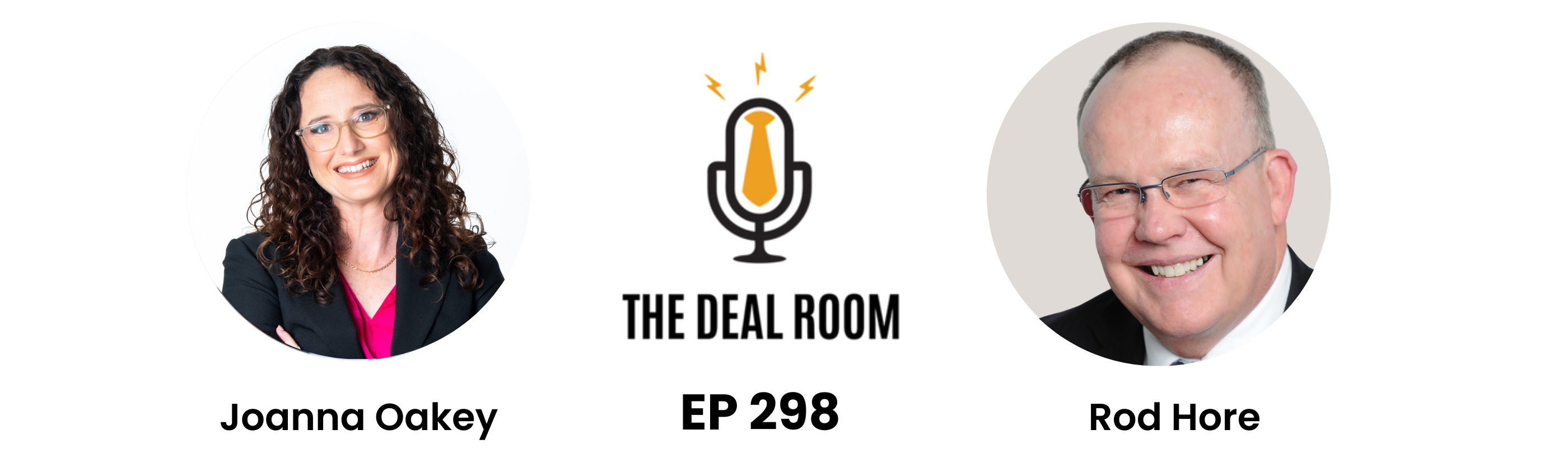
In this episode of The Deal Room Podcast, Joanna Oakey and Rod Hore explore the most common mistakes sellers of recruitment and professional services firms make, including misunderstanding working capital, the misalignment between vendor expectations and buyer realities, and why culture and leadership fit are just as important as the numbers.
In this episode, Part 2 of this 2 part series with Rod, Joanna and Rod dig into:
- Working Capital: Sellers can’t just take all the cash out — buyers expect enough left to keep the business running.
- Good vs Bad Debt: Funding growth = good. Funding day-to-day ops = red flag.
- Clean Balance Sheet: Keep it simple and tidy — no personal assets or messy accounts.
- Offshoring: Great for admin and repetitive tasks, but only works with proper onboarding and management.
- Valuation Myths: It’s not just about the multiple — recurring revenue and scalability matter more.
This is part 2 of this incredibly insightful two-part series, making it a must-listen insights for anyone involved in the services sector that is considering their equity value and strategy.
Tune in to The Deal Room Podcast now.
and if you missed Part 1, be sure to head here to check it out too!
ABOUT ROD HORE
Rod founded HHMC Global to provide industry acumen and global knowledge to owners and managers of recruitment agencies. Rod’s innovative business strategies and well-grounded guidance result in clients realising their personal and corporate goals.
Following a career in the IT industry, Rod has spent 25 years working with executives in the staffing and recruitment industry. His advisory roles include board assignments, merger and acquisition mandates, corporate strategy and valuations. Leaders trust Rod when conscious decisions are required for their future.
From his base in Perth, Australia, Rod travels extensively for his work with recruitment organisations.
Connect with Rod
Connect on LinkedIn (https://www.linkedin.com/in/rodhore/ )
Find out more about HHMC (https://www.hhmc.com.au)
Get a copy of Rod’s book: Business Valuations in the Recruitment Industry https://info.hhmc.com.au/ebook-download-business-valuations
He always welcomes the opportunity to talk with Staffing and Recruitment Industry leaders on all topics related to the business of recruitment, including offshore outsourcing. They can get into my diary using this link: https://calendly.com/rod-hhmc/30min-zoom
ABOUT ASPECT LEGAL
Joanna Oakey is Managing Partner of multi-award winning commercial law firm, Aspect Legal. We work with businesses across Australia as they buy strategically, grow cleverly and exit with maximum impact.
To book an initial consult (free) with our team, head to Book a Lawyer Now
(let them know “The Deal Room Podcast” referred you ;) )
Episode Focus: A deeper dive into practical considerations during a sale – including working capital, multiples, structuring deals – followed by a strategic look at offshoring, including risks, misconceptions, and opportunities in recruitment and beyond.
Timestamps
02:30 Working capital: why it matters and how sellers get it wrong
04:30 The emotional trap: sellers expecting to take out all cash
05:10 Good debt vs bad debt: how buyers view your funding model
06:15 Why a clean, simple balance sheet makes a business more sellable
08:00 Key value drivers: structure, working capital and future profit
11:00 How to actually earn a higher multiple—and avoid the “pub talk” trap
12:45 The evolution of offshoring in the recruitment industry
15:00 Misconceptions around outsourcing and how to avoid common pitfalls
18:15 Rod’s experience building offshore capability over 15 years
21:23 Bullish on 2025: Rod’s view on resilience and opportunity for SMEs
Joanna Oakey [00:00:24]:
Hi, it’s Joanna Oakey here and welcome back to the Deal Room Podcast, a podcast proudly brought to you by our commercial legal practise. Aspect Legal now today I’m talking with Rod Hoare, the managing director of HHMC Global. With 25 years of experience working alongside executives in the recruitment sector, Rod’s strategic guidance helps clients achieve their corporate and personal goals. I’ve known Rod for more than a decade. He is an absolute garnet in this space and I’ve worked with him on many transactions in the recruitment sector. This episode is part two of our two part series with Rod. Now don’t forget to go back to the show notes to listen to part one if you didn’t hear that. But in this episode, part two, Rod and I talk through navigating business sale financials, the key considerations for small business sales.
Joanna Oakey [00:01:22]:
We also talk about AI and varied adoption of AI across industries, obviously a topic that I’m very interested in. We talk about offshore outsourcing, the benefits and risks, and we also look at the bullish outlook for 2025. So without further ado, here we go with part two of our interview with Rod Hall. Maybe then if we step into another world that is a little bit complex, getting a little bit granular. Now, working capital, this is when we’re talking about this podcast, this is actually where we started. I, because I said look, I came to you when I said look, I just feel like we need to talk about working capital and business sales, share sales more often because I feel like this is one area where business owners really like just quite often haven’t thought, depending on how appropriately corporate they are or aren’t, may not have ever really thought about it in the context of the sale of the business. So I wanted to talk about that. And then of course we got talking about some of these bigger issues.
Joanna Oakey [00:02:32]:
But just coming back to that, that first starting point, what are the things that you think sellers and maybe buyers as well, buyers of varying sophistication get wrong? What are the things that are misunderstood when that topic of working capital comes up in a, in a sale environment?
Rod Hore [00:02:54]:
Yeah. Oh gosh, there’s this. It gets wrong in every particular way, doesn’t it? It becomes an emotional subject and it shouldn’t be because it’s just something to agree what you’re going to do and then you do it shouldn’t be complex. In most instances, if I’m talking about the standard or something like that, there is no standard. But in most instances in the services businesses that I work with, they’re sold as a going concern, which means that the minimum working capital needs to be kept in the business. Now that’s pretty simple concept, but it’s a bit of a black art to work out what minimum working capital might be. And so the accountants on both parties work on that and come up with a number. What gets complex is in the lead up to that, thinking about the owner of that business that’s going to sell and making sure that they’re making really sensible decisions so that they’re not destroying their take home pay when the deal is done.
Rod Hore [00:03:51]:
Okay, wouldn’t it be terrible if they had to tip more money in to the business to be able to keep it going, for example, as a going concern? So there’s all sorts of decisions. I talk about good capital and bad, or good debt and bad debt. That’s probably, let’s talk about debt rather than the other side of it. And so I love people having facilities in place in recruitment to be able to handle the big work that they’ve just won. And that’s usually cash flow related. And invoice funding is so common. But some companies actually fund that themselves and that’s good because they’re creating value for the future by doing that. You could call that a lazy balance sheet and so on.
Rod Hore [00:04:28]:
What I get concerned about is when people go and create debt for the running of the core business. Because I think for most recruitment agencies it’s a cyclical business. They reliant on certain clients and certain activities and those things can change overnight. And so having debt for the running of the core business to hire new staff or to pay the rent or to do a fit out or whatever it might be, that seems to be a high risk activity for me. But having debt for cash flow, I’m very comfortable with that. If you’ve got debt for cash flow, it means that your balance sheet is then not as tidy and easy to understand as it might be otherwise. Which leads to another point is that every small business should have a really boring and simple and clean balance sheet. Because if you have personal assets in there and so on, it does tend to frighten off the buyers.
Rod Hore [00:05:18]:
So keeping the balance sheet really clean is important. But this process of Working through and saying, what money do you need to leave in the business when you sell it as part of the sale price is misunderstood and becomes emotional. As I said, the good thing is anything above that agreed number you can take out, take it as a dividend or whatever it might be and you can withdraw it prior to the sale. So we’ve sold businesses and you and I worked on one of them together, where the value of the business was less than what he took out of his working capital, his excess working capital, because he’d run an exceptionally lazy balance sheet. And that’s some people’s wealth creation process that. And everybody has their own approach to it, but they do need to think about the balance sheet. And 99% of the time they only think about the P and L and they don’t actually concentrate on what’s the state of my working capital, what decisions am I making about how I’m funding the business and so on.
Joanna Oakey [00:06:17]:
And it’s such a good point because I do find many sellers come to this point of sale and they’re like, hold on, I thought I could take all the cash out of the beautiful.
Rod Hore [00:06:26]:
It’s a misconception that’s out in the market.
Joanna Oakey [00:06:29]:
This is mine, right? This is mine up until completion. And they. It’s that, hold on, the seller’s wanting me to essentially they see it as give them cash as part of the deal so that there’s working capital left in the business. One and one thing just before we go on the. I think it is also important to say when you’re talking about debt for cash flow being. I think in particular in recruitment, we have these recruitment businesses that are very heavy on temp. They’re temp rather than permanent recruitment businesses.
Rod Hore [00:07:04]:
That’s right.
Joanna Oakey [00:07:05]:
So I think it’s that temp side in particular where this working capital discussion is so important. But what’s your response then to the business owners who come in? I don’t get all the cash that’s sitting in the bag. Kick out.
Rod Hore [00:07:19]:
Hopefully whoever’s been talking to them has been saying that you will need to leave appropriate working capital so that the business is a going concern. And they have some discussion about that ahead of time because otherwise they’ve been misadvised. Basically, we always, by the way, for the smaller the business, the more this applies. There’s three functions that you need to consider when you’re selling your smaller business. They apply to bigger businesses as well, but they become really under the spotlight. The first is what’s the structure of the deal? In other words, what risk am I being asked to take as part of this? Do I have to stay for another three years? Do I get paid in shares in that business? Oh, so I’m buying your business, I’m not selling mine. All of that conversation. What risk am I being asked to take? The second thing is working capital.
Rod Hore [00:08:02]:
How much am I going to be able to withdraw and how does that get added to the spreadsheet of how much I get to take home? And then the third one is, what’s the value of the business? What’s the multiple of profit or something like that that people are prepared to pay? And the third one sorts itself out and the first two are able to be influenced by the owner. Okay, I really want people to focus on the first two, not the pub talk, which is what’s the multiple? Okay, the market sorts that out. That’s actually usually not too much of a debate. But the first two are very much open to all sorts of interpretation and the owner should understand what’s possible and they should understand what the buyer is trying to achieve so that they can help the buyer achieve.
Joanna Oakey [00:08:46]:
So there’s two things I wouldn’t talk about there, just one very quick point. The businesses that you deal with at sale may be larger than many of the businesses that we’re dealing with that might be listening to this podcast. Just one thing I wanted to say on working capital. Quite often, whether working capital is expected to be left in the business is a function of the size at sale and what the sale price is. There’s certain deals where essentially the buyer’s not paying enough to expect that there may be working capital in the business. So that’s the first trip. But the deals that generally you do with one more sophisticated generally where that would be an expectation to buy because of the price that they’re paying. So I guess that’s the.
Joanna Oakey [00:09:31]:
And working capital is essentially part of that concept of understanding how evaluation has been reached, the value of the business has been reached as well. Right?
Rod Hore [00:09:40]:
Yes.
Joanna Oakey [00:09:41]:
So that’s the first thing. But the second thing is to this sort of pub talk around, what’s the multiple? I do think the one usefulness of that multiple discussion, the discussion about multiple is multiple is very important in terms of essentially what a buyer gets, a seller gets in their pocket. At the end of the day, if you’re running a business that worth with an ER of a million, say or 500 grand or whatever, if you’re in a three times multiple versus an eight times multiple, that’s a big difference. In DEP, but the type of business that will, there are differences in the business itself that will enable them it to access a larger pool of buyers and a more sophisticated buyer that would be paying a higher multiple. So there’s reasons why some businesses will achieve a higher multiple than others. Obviously, for all of these reasons that you’re talking about in relation to that appropriately corporate really concept, it comes back to that, right? The more appropriately corporate, the more attractive you are to a sophisticated buyer and therefore the higher the opportunity to reach a greater multiple. And so therefore, I think the pub conversation about multiple is useful in early stage exit planning for how am I going to create my business into something that has value at exit? Maybe that’s where it’s particularly useful.
Rod Hore [00:11:09]:
That’s true. But the hesitation is. And you actually answered my question here by saying if somebody has got a very predictable revenue stream out into the future, they are worth more than somebody who does contingent permanent placements where they have to fight every Monday morning to start again. And so the trouble, the pub talk is it never gets to that level of compensation. It’s, oh, he got five times, I’m worth five times. No, you’re not. You’re actually unsellable. It’s the next level of conversation in all of that is actually valuable.
Joanna Oakey [00:11:40]:
How do you turn yourself into that business that didn’t get the five days?
Rod Hore [00:11:43]:
Yeah, that’s right. So if you want to get out now, this is the reality. If you want to build a business that has value, here’s some choices you’ve got to make going forward. Yeah.
Joanna Oakey [00:11:51]:
Love it. Love it. Wow. I feel like we’ve covered a lot here, Rose, is there anything else you felt like we should be musing about today?
Rod Hore [00:12:00]:
One of the reasons that one of the things you did last year was you had a very popular podcast on offshore outsourcing.
Joanna Oakey [00:12:06]:
Yeah.
Rod Hore [00:12:07]:
And how was the feedback on that and how did that go? Because that is now a big topic within the recruitment industry.
Joanna Oakey [00:12:13]:
Yeah.
Rod Hore [00:12:13]:
If I can give the 10 second reason I say that is that it’s about 15 years since I’ve been very interested in the offshore outsourcing business and actually been working with a company that has grown quite rapidly and for a decade nobody wanted to talk about it in Australia, even though it was exceptionally popular in the US and the uk. Along came Covid and now it’s a hot topic of conversation in Australia as well. So there’s been a dramatic change in the last four years or so in terms of offshore outsourcing within the recruitment industry.
Joanna Oakey [00:12:45]:
Yeah. I was going to say, I love that you added that last bit because that is a function of an industry by industry basis.
Rod Hore [00:12:51]:
Yes, that’s right.
Joanna Oakey [00:12:52]:
We look at certain industries like the accounting industry.
Rod Hore [00:12:55]:
Yeah, it’s been popular forever.
Joanna Oakey [00:12:57]:
Yeah, exactly. And it’s interesting because I’ve watched this acceptance and uptake by different industries over the last decade and the very big difference between industries and indeed we are going to see the same thing. We’re just at the tip of the iceberg of AI at the moment, but we’re going to see the same thing with that AI. Each industry will adopt AI efficiencies in different speeds and at different time frames. But I think there’s a massive opportunity in offshoring and outsourcing just affect every single industry. But the challenge in every industry is to rework, to be pioneers, to rework ideas from cross pollinate ideas from other industries into their own.
Rod Hore [00:13:48]:
Yes.
Joanna Oakey [00:13:49]:
And I think that was the opportunity.
Rod Hore [00:13:51]:
Not to see it as a panacea. I’ve always had this view that if you’re looking at all of the chess pieces, you’ve got to be able to solve a problem or to execute a growth strategy or to whatever it might be. You want offshore outsourcing to be one of the pieces on the board. But that doesn’t mean to say that it taking away the opportunities that technology AI give you or it takes away how you’re going to use your onshore staff or what you’ve got to do for compliance or how your leadership and culture and everything is going to be developed. It’s just another piece on the board. And my view has always just been that you’d be really silly not to have the piece on the board. Now you’ve got the piece on the board, let’s have a discussion about how you can solve the problem. It gives you other options for how to solve the problem.
Joanna Oakey [00:14:36]:
And challenge, challenge yourself as a business owner to go deeper than just the initial immediate pushback that happens in your industry as a whole. I mean you. I think a lot of the issues in the recruitment industry is that a lot of the selling is one to one. And a lot of this pushback has been concern about professionality and elements of, elements of delivery of client relationships that are seen to be have problems when we deal with an outsource or an offshore environment. And same will happen with AI.
Rod Hore [00:15:17]:
But of course it will.
Joanna Oakey [00:15:18]:
Yeah, yeah. But I just, I do find that there’s a lot of limitations in the way business owners look at some of these concepts on the basis of how the problems occurring in other industries for offshoring, we quite often look back at the issues that have happened in offshore call centres, for example, and difficulty in client bases with people feeling they’re not getting answers to questions they have. But the true issue there is a lack of training of staff. It’s not the concept of civilization when we’re outsourcing. So it’s a misaligned objection to the concept, I think, and that’s something any business owner should be challenging themselves.
Rod Hore [00:16:02]:
I’ve always thought of offshore outsourcing. As I’m about to hire these five people and I need to onboard them like I would one of my staff members and I need to train them and include them and provide leadership and provide coaching and mentoring and all that sort of stuff as though they’re part of my staff. It’s just there’s another couple of levels of complexity on top of it, which is why you only do it if it’s cheaper. You wouldn’t do it if it’s more expensive because you die locally. And the other couple of levels which I think get pushed aside a little bit. One is how much risk are you prepared to take? Are you dealing with somebody where you’re directly paying somebody, they’re working at home off their own PC, you don’t know if they’re ghosting you all of those sorts of issues through to a sophisticated business process outsourcing organisation that is got privacy and cybersecurity and everything else covered for you and will sign a contract to say they’ve got it covered. You’ve just got to choose where you’re going to be and how you’re going to do it. And again, some of the pub talk doesn’t necessarily help.
Rod Hore [00:17:03]:
Oh, yeah, I’ve found somebody in whatever country to help me do this. You go, what does that mean? How are you paying them? What are you liable for? Are you breaking any international laws? Are you slavery active? There’s a whole range of things in there that. That don’t get talked about enough.
Joanna Oakey [00:17:19]:
Yeah. At a level outside of the pulp with you.
Rod Hore [00:17:23]:
Exactly. Anyways, that’s part of the growing up, though, isn’t it? Is that people go from treating it like, oh, I don’t know, you can go into upwork or freelancer.com and you can get a task done. But if you’re talking about offshore outsourcing, which is part of your process and your ongoing process, it’s not a task and you’ve got to treat it differently and you’ve got to take suitable and appropriate decisions on how to handle something.
Joanna Oakey [00:17:48]:
Yeah, and I think you’re absolutely right. I think it’s treating the concept of offshoring and outsourcing, treating everyone still as part of a team. Like there really has to be no delineation of where work is done and who work is done by. The business should be taking responsibility of training, onboarding and treating staff the same wherever they. I think that’s where the gaps occur.
Rod Hore [00:18:15]:
But look, the business case is quite compelling. If you’ve got tasks which are administrative in nature or are process oriented and repetitive and you are not considering offshore outsourcing for those tasks, then your peers are and they’re probably doing something for significantly less cost and maybe more efficiently than you are. The business case is there and I don’t think it’ll diminish. Yeah, there was a. The World Employment Federation, I think WEF. I think that’s what it’s called. The World Employment Federation actually made a great quote years and years ago and it said, we don’t have a skills problem in the world, we just have skills in the wrong place. And offshore outsourcing is one of the ways of actually handling that.
Joanna Oakey [00:18:58]:
Yeah, Isn’t it that? Fascinating comment. I believe in a global village and so maybe. Why don’t you just tell us a little bit about your involvement in that area, Rod, over and above. Of course, for years and years you have experience working with offshore staff yourself and making that work from a business perspective. Maybe tell us where you are right now. How do you work in this area?
Rod Hore [00:19:23]:
Yeah, we got introduced to a relatively young company in India 15 years ago. So when I went to India in last month, in January, it was my 15th year that I’d been going over there and that little company, which was less than 100 people at the time, is now 3,000 people across the Philippines and India. And I’d like to say I’ve contributed to that. Can’t claim much credit, I don’t think. And it’s a great organisation. It’s been very successful. It purely works in the recruitment industry and has basically a thousand people get up and go to work the US shift and a thousand people get up and go to the work in the UK shift and so on. And it’s been fascinating for me to not only watch the growth and the level of sophistication and to see some of the successes and the failures and things that need improvement, but also then to come back and talk to organisations in Australia and New Zealand about that, because I suppose I’ve got a little more knowledge than some others because I’m watching that organisation grow and tackle problems and understand how to deal with things like how do they work with an organisation that’s got a contract with the Federal government, for example.
Rod Hore [00:20:27]:
All of those sorts of things that need to be worked through. And then we became a client as well. And for years, I don’t know how many years, but close to 15, our database management and marketing support and so on has all been done by that organisation as well. So it’s enabled us to remain really nimble and probably not the best person and most structured person, but it’s probably put a little bit of structure and organisation behind what we do and how we approach some of those areas. I’m a genuine advocate for it, but I’m an advocate for it with my eyes wide open in terms of privacy and all of the things that come with that and making sure that you do things correctly.
Joanna Oakey [00:21:04]:
Love it. Okay, wonderful. Maybe we can push some links in the notes then. How about we do that? I think that’s it. Rod, I just want to say a massive thank you for coming onto the show, as always. I love it. I love our annual podcast. Catch up here.
Joanna Oakey [00:21:20]:
Anything you wanted to leave our audience with.
Rod Hore [00:21:23]:
Look, I’ve entered 2025 with a really bullish outcome outlook, I should say, and I’m not sure that’s really justified when you look at all of the craziness that goes on in the world. But I think, as usual, our local economy is really resilient. I sit in Western Australia, so maybe I’m a little more bullish than others might be. And I don’t think, barring major external influences, we should have things to worry about. And basically we should put our head down and get on with it, because we’re in a very fortunate position.
Joanna Oakey [00:21:50]:
I love it, Rod. What a great way to leave it off. Of course, I’m always optimistic about the year to come, but I agree, I do feel that what I saw last year actually just more generally across the market as a whole of SMEs, was it was a bit of a bouncy, patchy year. And certainly interest rates, I feel, were a bit of a dab damper on our buy. A little bit finance, a little bit more tricky last year than it had been in the past, interest rates a little bit more live. Obviously, the cost of capital is an important factor in considering acquisition and also just consumer confidence, business confidence as a whole. And that’s where I feel like we’ve got. I think we’ve hit a plateau.
Joanna Oakey [00:22:35]:
I think we’ve hit a bit of stability there. So I’m very bullish about 2025, Rod, exactly like you. It’s the main thing.
Rod Hore [00:22:43]:
Make it a trend, make it a trend.
Joanna Oakey [00:22:46]:
Love it, Rod, as always, thank you so much for your time.
Rod Hore [00:22:49]:
All right, thanks, Joanna.
Joanna Oakey [00:22:52]:
Well, that’s it for this episode of the Deal Room Podcast. We hope you’re now primed for your next deal with these pointers and have enjoyed these fascinating insights. Now, if you’d like more information about this topic, then head over to our website at thedealroompodcast.com, where you’ll be able to download a transcript of this episode as well as access any contact details and any other additional additional information we referred to in today’s podcast. Now, if you’d like to get in contact with our guests today and the services they offer, you can go ahead and check out our Show Notes for a link right through to them and their details. You can also book in directly with our Legal Eagles at Aspect Legal if you’d like to soundboard your next steps, discuss a legal question, or find out more how we can assist, whether that’s with buying or selling a business, or perhaps somewhere in between. Now, don’t forget to subscribe to the Deal Room Podcast on your favourite podcast player to get notifications whenever a new episode is out. We’d also love to hear your feedback, so please leave us a review and rating if you’re already one of our subscribers, or even if you’re listening to this podcast for the very first time. Every review helps our team produce valuable content for you.
Joanna Oakey [00:24:10]:
Well, thanks again for listening in. You’ve been listening to Joanna Oakey and the Deal Room Podcast, a podcast proudly brought to you by our commercial legal practise, Aspect Legal. See you next time, ladies and gentlemen.
Disclaimer:The material contained on this website is provided for general information purposes only and does not constitute legal advice. You should not depend upon any information appearing on this website without seeking legal advice. We do not guarantee that the contents of this website will be accurate, complete or up-to-date. Liability limited by a scheme approved under Professional Standards Legislation